
 Official differences training
TailwheelDifferencesTraining
Official differences training is required before you fly a tailwheel aeroplane. It covers both theory and practical flying with an instructor.
- animated slides
- 151
- animated slides
- chapters
- 11
- chapters
- and a course exam
- 11 tests
- and a course exam
Free preview
How a ground loop develops
Watch a small swing on the landing roll grow into a turn that can no longer be stopped, and see exactly why a tailwheel aeroplane does it. This is slide 3 of chapter 5, The Ground Loop, recorded as it plays in the course. Turn your sound on to hear the narration.
Tailwheel Differences Training· Chapter 5 · Slide 31:19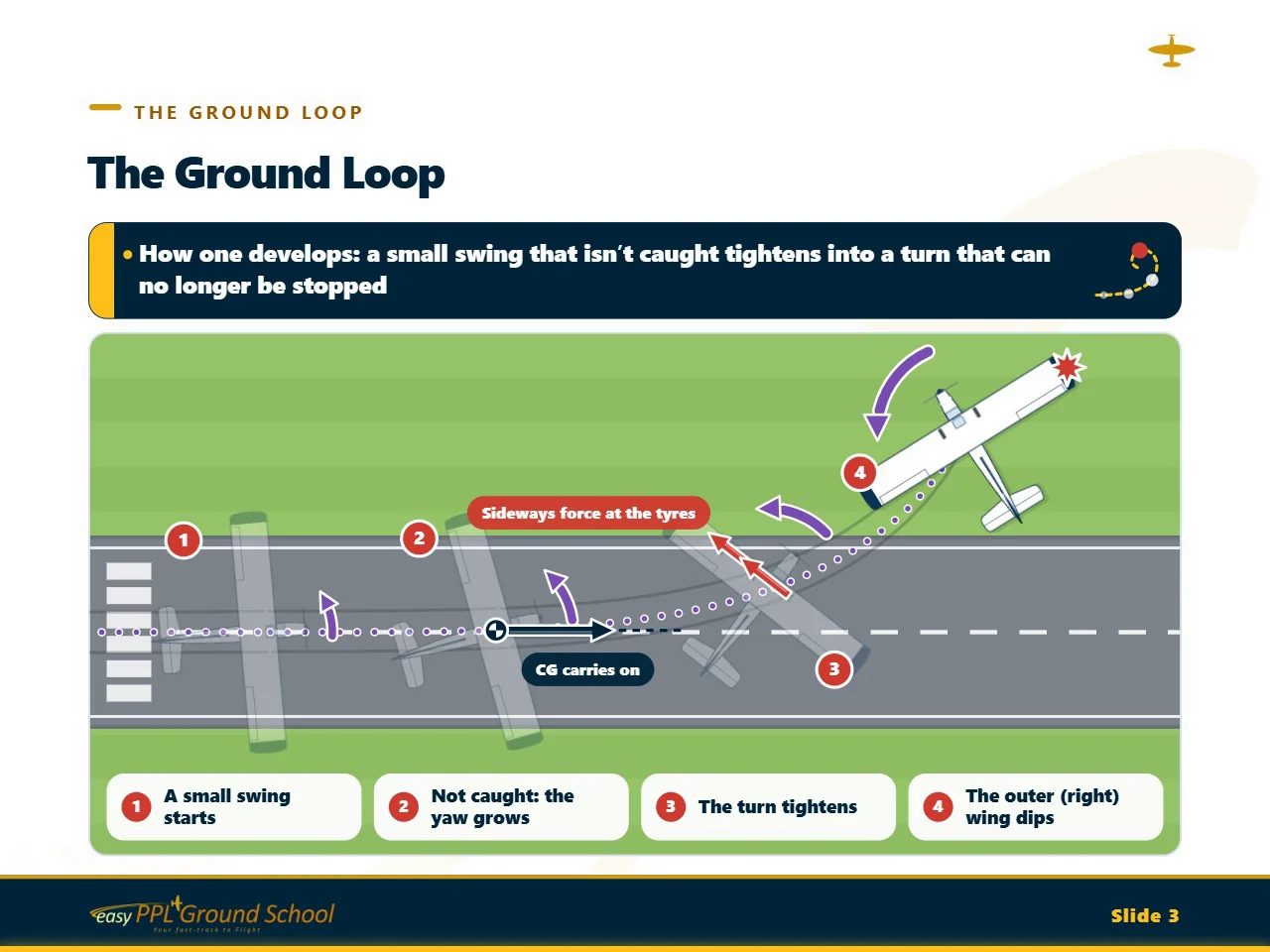
- Every slide is animatedEach step builds up as the narrator explains it, at the pace you can follow.
- The physics, drawn on the aeroplaneSwings, forces and airflow are drawn on the aeroplane itself, so you see why it happens.
- Classic slides tooSwitch to Classic to see each slide as a still picture with a short summary.
The course
What you'll learn
This course teaches the theory, following the CAA's tailwheel differences training syllabus heading by heading: the physical differences, loading and the effect of the centre of gravity, why a tailwheel aeroplane wants to swing and how a ground loop develops, ground handling and taxiing, taking off, engine failure on take-off, three-point and wheel landings, crosswinds, and parking and mooring. Your training flights with an instructor then put it into practice.
Every chapter ends with a progress test, and the course ends with a course exam. The course is for single-engine aeroplanes.
To prove you have completed the course, after you have passed our on-line exam you will be issued with a Course Completion Certificate.
The one difference
Where the weight sits changes everything
On a tailwheel aeroplane the centre of gravity sits behind the main wheels; on the nosewheel aeroplane you learnt on, it's ahead of them. That one difference explains almost everything in this course.
- 01
A swing grows by itself
Once it yaws, the CG carries on and the tyres pull sideways, so the turn tightens unless you stop it early with rudder.
Chapters 3 to 5
- 02
It weathercocks into wind
Most of its side area is behind the main wheels, so a crosswind turns the nose into wind on the ground.
Chapters 4 and 10
- 03
Heavy braking can tip it over
Brake hard and the CG's momentum lifts the tail, bringing the propeller down towards the ground.
Chapters 3, 6 and 8
Course contents
Four parts, 11 chapters
The course follows the CAA's tailwheel differences training syllabus heading by heading, for single-engine aeroplanes. Every chapter ends with a progress test.
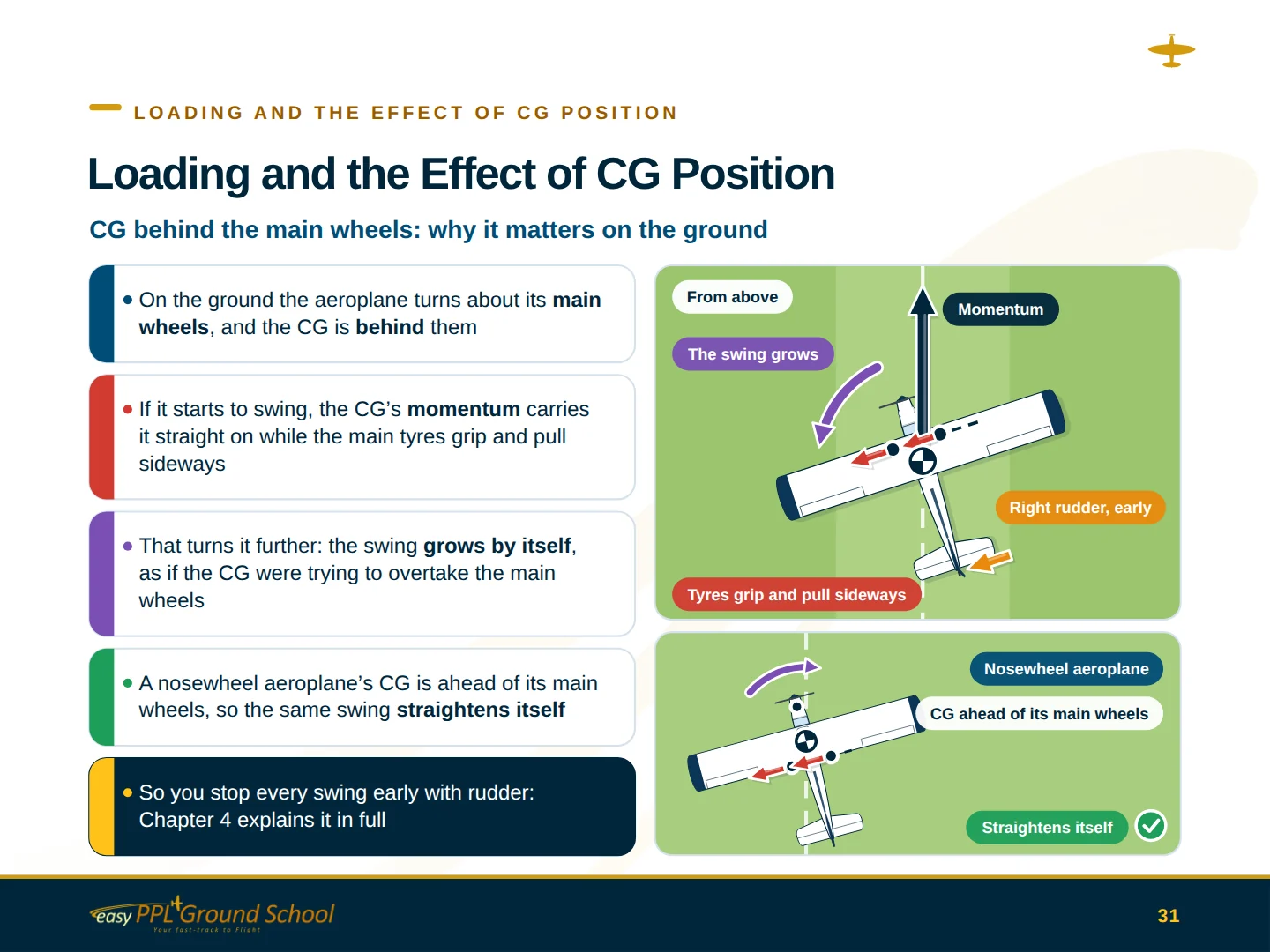
From the course · CG behind the main wheels 01Part 1
The aeroplane
What makes a tailwheel aeroplane different to look at, sit in and load, and why the rules ask for training.
- 1IntroductionWhat makes a tailwheel aeroplane, why the rules ask for training, how it's done and signed off, and the aeroplane used through the course.14 slides Progress Test 1
- 2Physical DifferencesMain legs and tailwheels, heel and toe brakes, differential braking, the three-point attitude, the view over the nose and propeller clearance.14 slides Progress Test 2
- 3Loading and the Effect of CG PositionWhere the weight sits, why a CG behind the main wheels matters, aft and forward CG, the nose-over, loading the cabin, and mass and balance.12 slides Progress Test 3
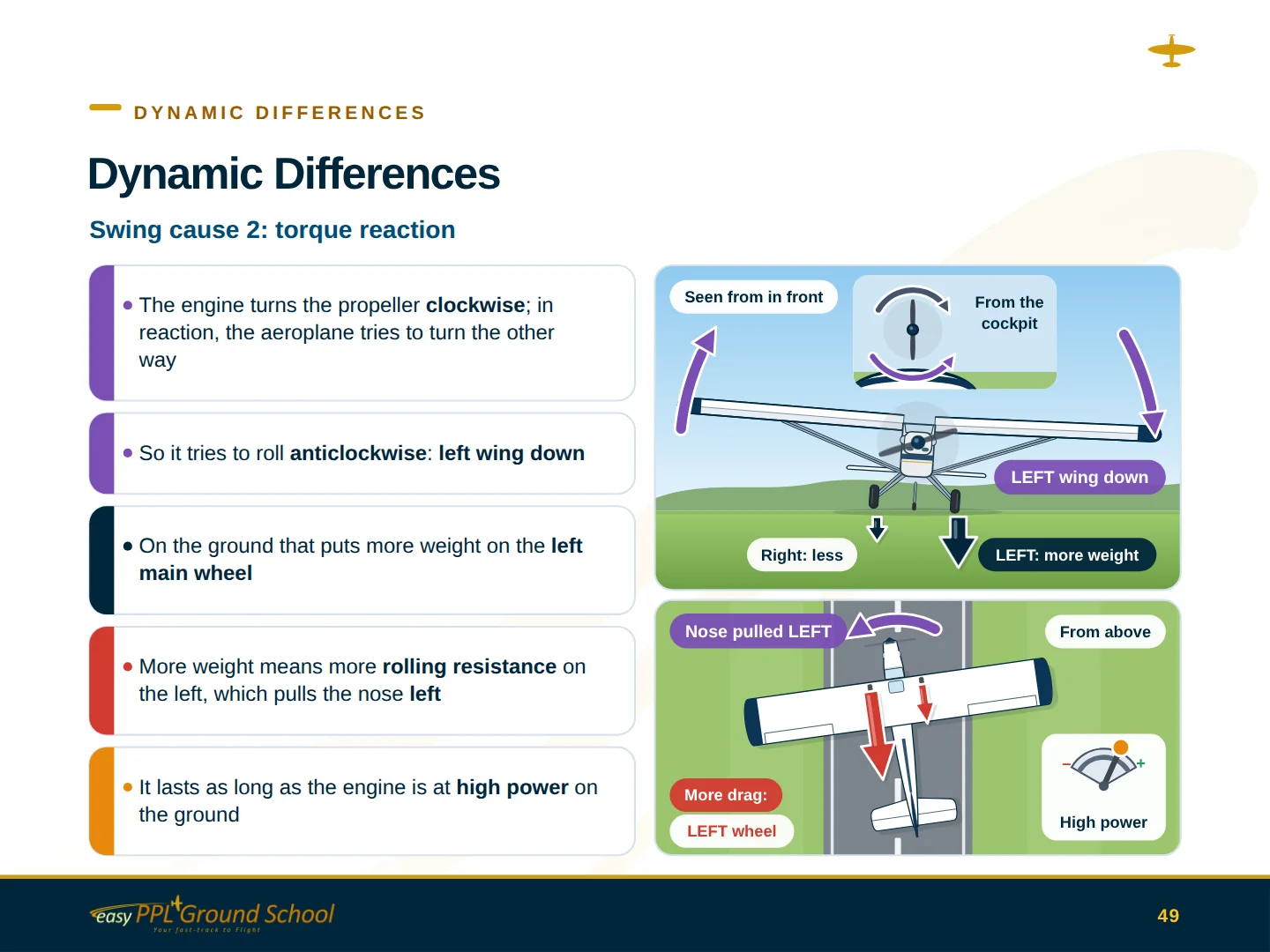
From the course · Torque reaction 02Part 2
Why it swings
Directional stability, weathercocking, the four reasons it swings left, and how a ground loop develops.
- 4Dynamic DifferencesDirectional stability, weathercocking, fin and rudder shielding, rudder effectiveness, and the four causes of the swing to the left.15 slides Progress Test 4
- 5The Ground LoopWhat a ground loop is, how one develops and what can follow, the usual causes, how to prevent one, and recovery early and late.11 slides Progress Test 5
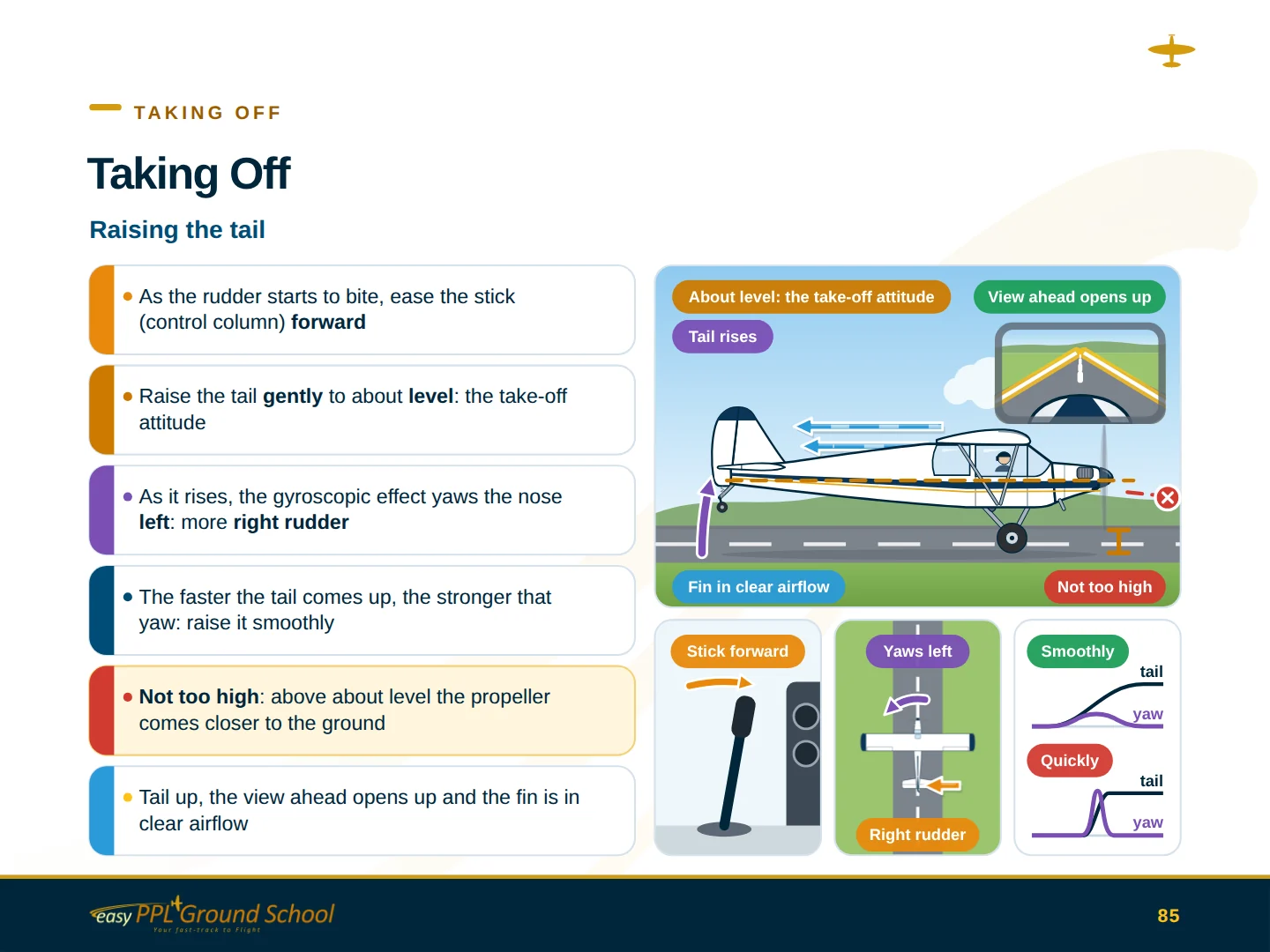
From the course · Raising the tail 03Part 3
On the ground and into the air
Moving, starting and taxiing it, the take-off from lining up to the climb, and an engine failure on take-off.
- 6Ground Handling, Starting and TaxiingMoving it by hand, the tailwheel pre-flight checks, starting, taxiing and S-turns, steering, braking, taxiing in wind and the run-up.14 slides Progress Test 6
- 7Taking OffLining up, the three phases of the take-off run, opening the throttle, raising the tail, lift-off and climb, and short and soft fields.11 slides Progress Test 7
- 8Engine Failure During Take-offAbandoning on the ground roll, the swing and the nose-over, landing ahead with or without runway left, choosing a field, and partial power.14 slides Progress Test 8
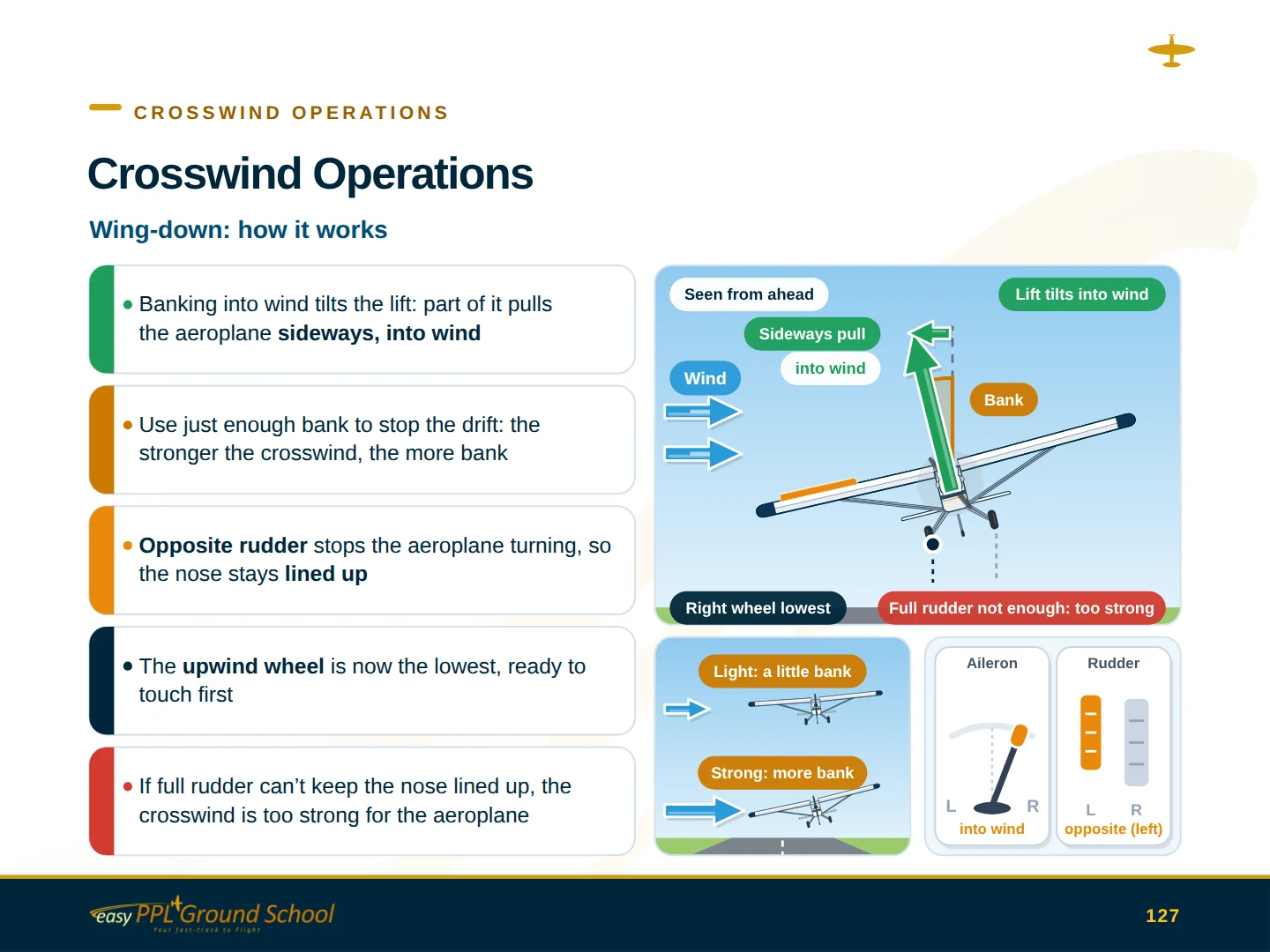
From the course · Wing-down 04Part 4
Back on the ground
Three-point and wheel landings, crosswinds from the approach to the roll-out, then parking and mooring.
- 9Landings: Three-Point and Wheel LandingsThe approach, the three-point landing and its picture, the landing roll, wheel landings and lowering the tail, bounces, balloons and the go-around.15 slides Progress Test 9
- 10Crosswind OperationsWhy crosswinds matter more, touching down with drift, taxiing and taking off, crab and wing-down approaches, the touchdown, gusts and limits.13 slides Progress Test 10
- 11Parking and MooringWhere to park, shutting down and securing, chocks and tie-downs, controls and covers, strong winds, and into and out of the hangar.11 slides Progress Test 11
- Step 1Learn it hereThe theory of every syllabus heading, with a progress test after each chapter.
- Step 2Fly it with an instructorGround handling, take-offs, three-point and wheel landings, and crosswinds as the weather allows.
- Step 3Logbook signedWhen you're consistently safe, your instructor signs your logbook.
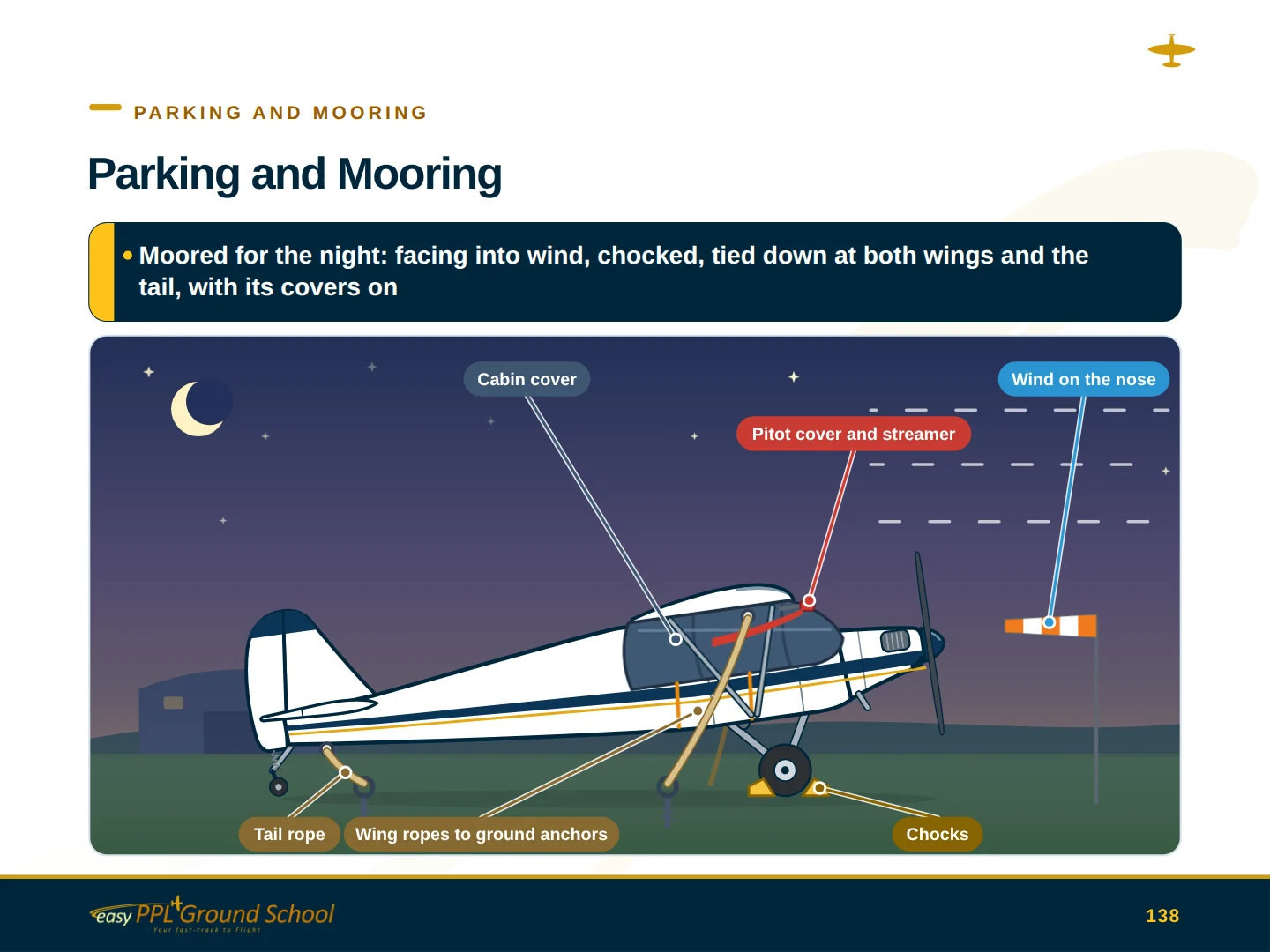
What's included
Everything you need, in one place
- 151 animated slidesEach one built up step by step while a narrator explains it, in 11 chapters.
- Classic slides tooPrefer still pictures? Switch to Classic for each slide with a short spoken summary.
- 11 progress testsOne after every chapter, and every answer explained with a picture.
- Course examExam-style questions on the whole course to finish.
- Certificate of completionYours when you pass the course exam.
- Kept up to dateUp-to-date material that stays up to date.
- Study anywhereOn your computer, tablet or phone.
Buy it now
Choose how you study
Full Course
£15.49for one month
Renew for £13.94 a month
- Every lesson in the course
- 11 progress tests
- The course exam
- 1 certificate
Test/Exam Access Only
£13.99for one month
Renew for £13.99 a month
- 11 progress tests
- The course exam
- Ideal for revision
No account needed to add to your basket: you'll register (free) at checkout, and your course opens as soon as you've paid.