
 PPL(H) and LAPL(H) theory
Principles of FlightHelicopter
Having an understanding of how a helicopter flies goes a long way to determining your practical handling of the aircraft.
- animated slides
- 318
- animated slides
- chapters
- 13
- chapters
- and a course exam
- 12 tests
- and a course exam
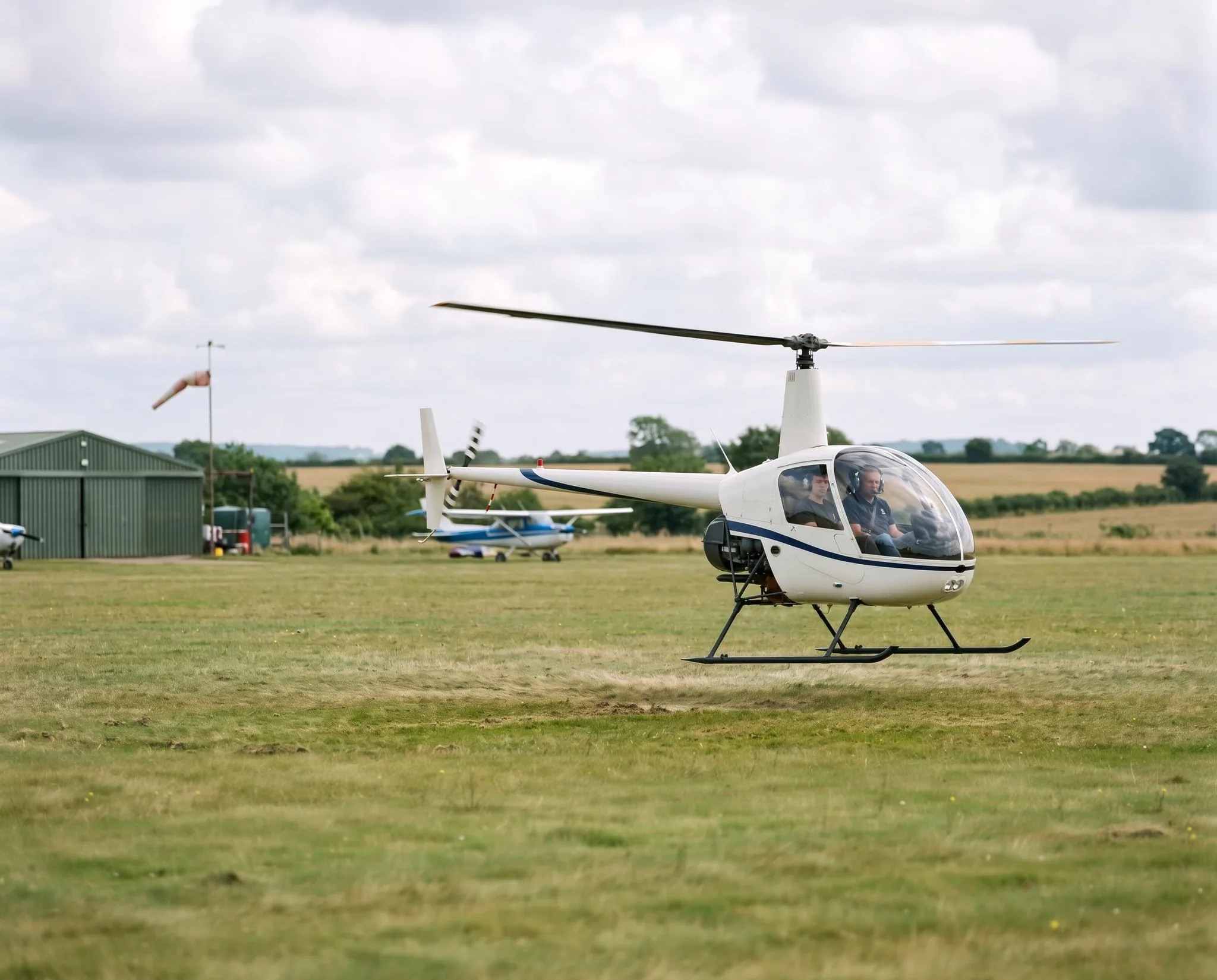

Free preview
Watch a slide from the course
Move the cyclic and the swash plate tilts, so each blade's pitch rises and falls once every turn. This is slide 10 of chapter 5, Rotor Control, recorded as it plays in the course. Turn your sound on to hear the narration.
Principles of Flight (Helicopter)· Chapter 5 · Slide 100:50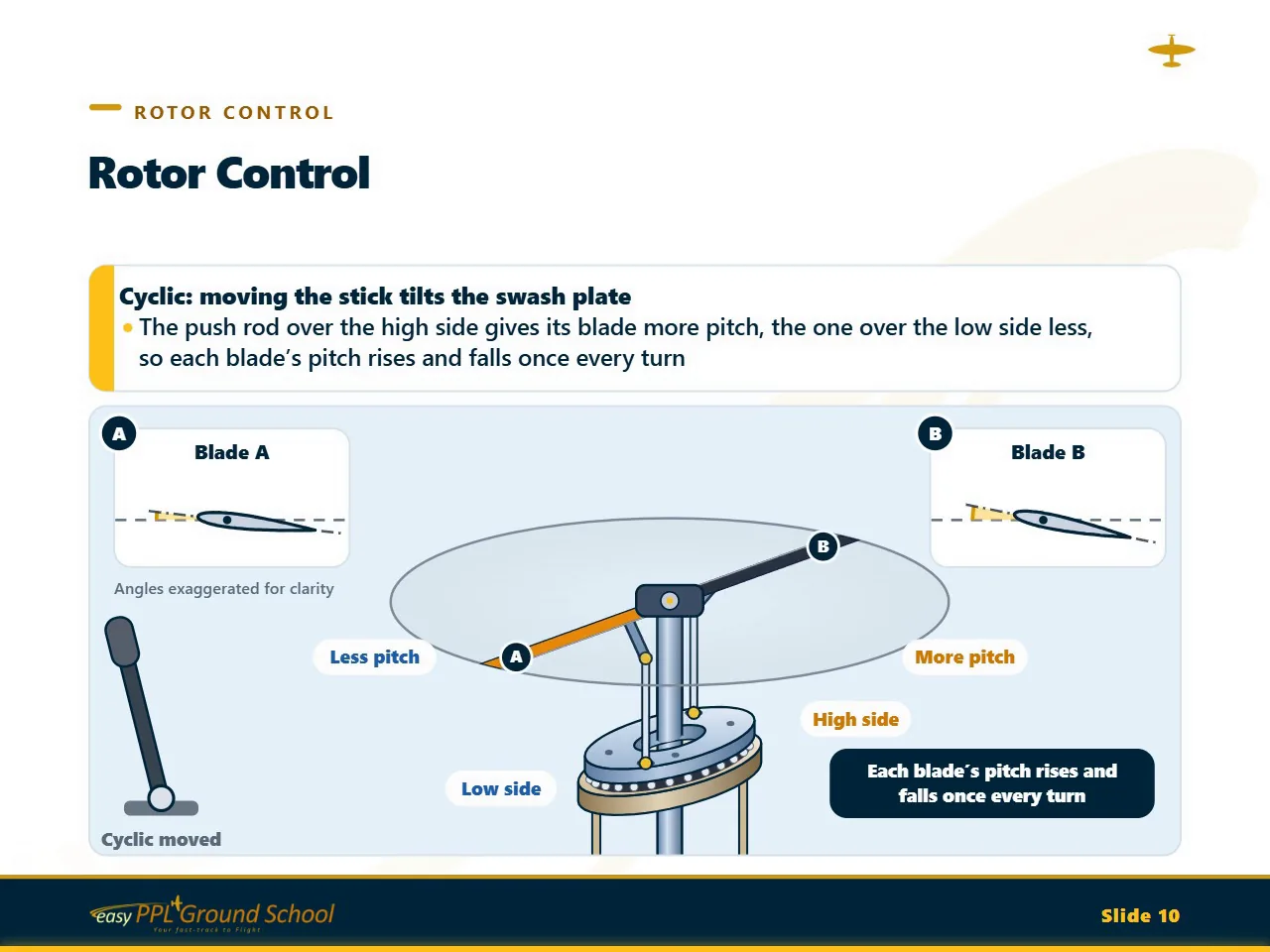
- Every slide is animatedThe diagrams build up step by step as the narrator explains them.
- You set the pacePause, go back a slide or change the speed whenever you like.
- Classic slides tooSwitch to Classic to see each slide as a still picture with a short summary.
The course
What you'll learn
This course is one of the theoretical knowledge subjects required for the issue of a Pilots Licence for Helicopters, and it follows the UK PPL(H) syllabus for Principles of Flight.
It starts with the atmosphere and the aerodynamics every aircraft shares, then covers the helicopter itself: the rotor and its controls, phase lag, the tail rotor, vertical flight and ground effect, transition, autorotation, ground resonance, vortex ring and blade sailing, stability, and the limits to high-speed flight.
A progress test closes each chapter, and the course ends with a course exam. At the end of this course, you will have a thorough grounding in the relevant aspects of the subject matter that you will use in your everyday flying.
To prove you have completed the course, after you have passed our on-line exam you will be issued with a Course Completion Certificate.
Course contents
Four parts, 13 chapters
The course starts with the air and how lift is made, then the rotor, then flying the helicopter, and ends with its hazards and limits. Every chapter from the second on ends with a progress test.
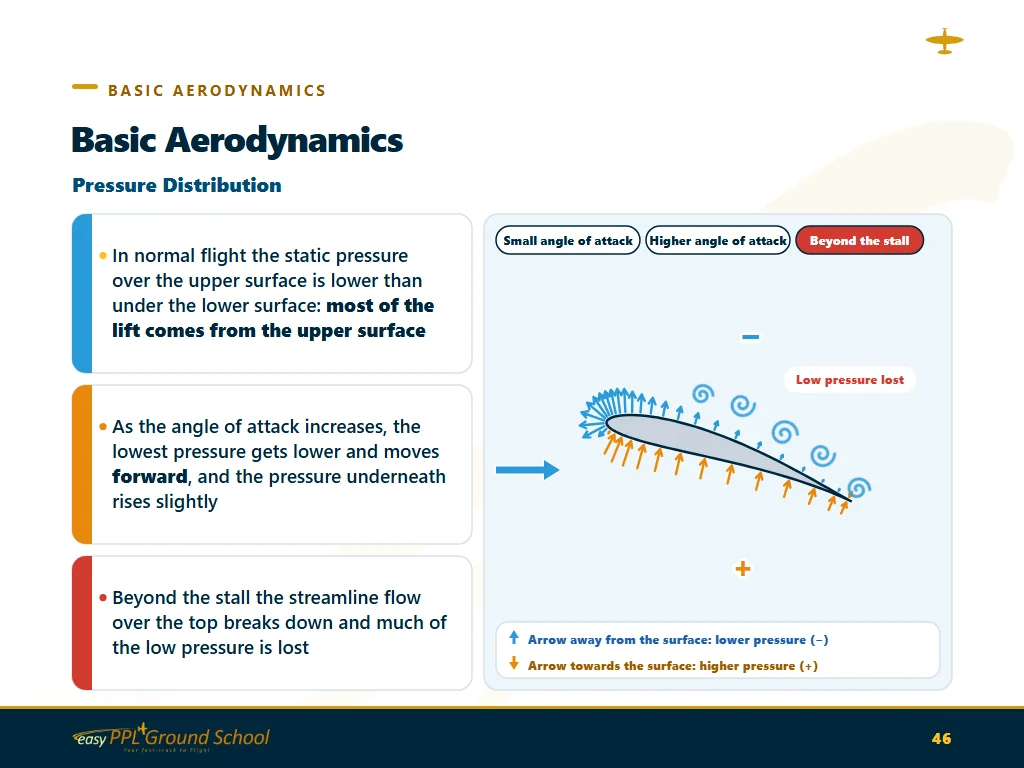
From the course · Pressure distribution 01Part 1
How lift is made
The air itself, then the aerodynamics every aircraft shares, explained with the rotor blade.
- 1IntroductionHow the course works, why the helicopter flies the way it does, and how a rotor makes lift.8 slides
- 2The AtmosphereThe atmosphere's layers, pressure, temperature and density, the gas laws, the ISA and density altitude.21 slides Progress Test 1
- 3Basic AerodynamicsThe forces in the hover and in forward flight, airflow round an aerofoil, lift, the types of drag, and airspeed.34 slides Progress Test 2
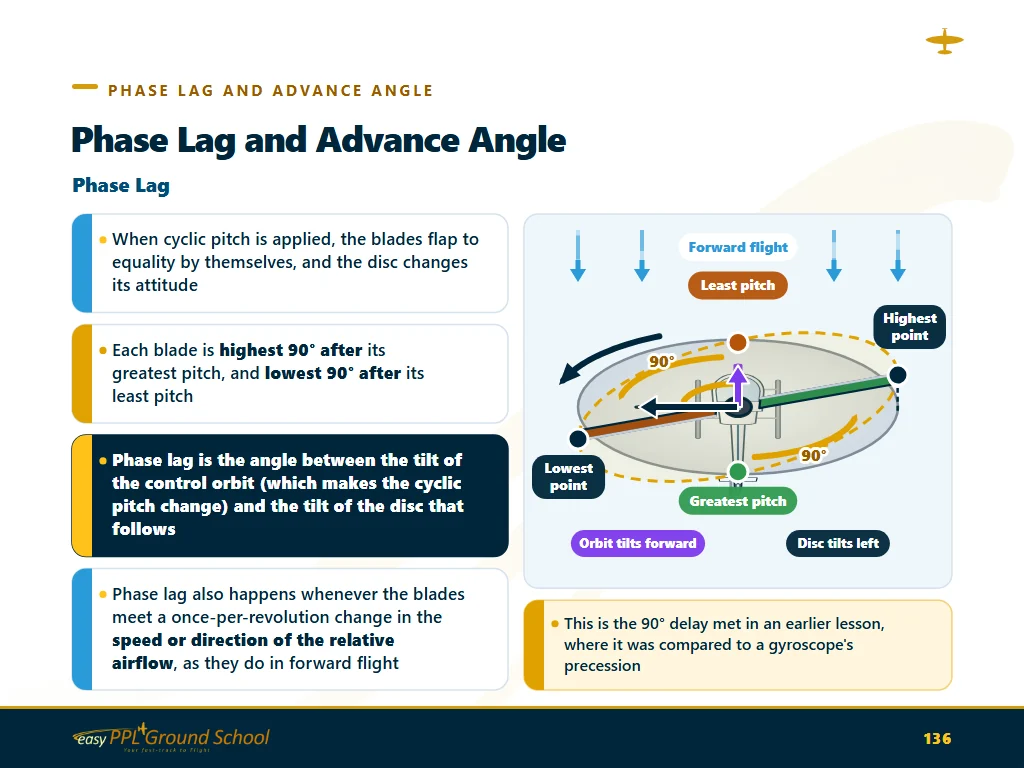
From the course · Phase lag 02Part 2
The rotor
How the rotor makes thrust, how the controls reach the blades, and what the tail rotor does.
- 4Rotor AerodynamicsInduced flow, relative airflow, pitch angle and angle of attack, rotor thrust and rotor drag, and tilting the disc.35 slides Progress Test 3
- 5Rotor ControlFeathering and the swash plate, the collective and cyclic, dissymmetry of lift, flapping, coning and dragging.27 slides Progress Test 4
- 6Phase Lag and Advance AngleThe control orbit, why each blade flaps highest 90° after its greatest pitch, and the advance angle.19 slides Progress Test 5
- 7The Tail RotorTorque reaction, the tail rotor and heading control, tail rotor drift and tail rotor roll.14 slides Progress Test 6
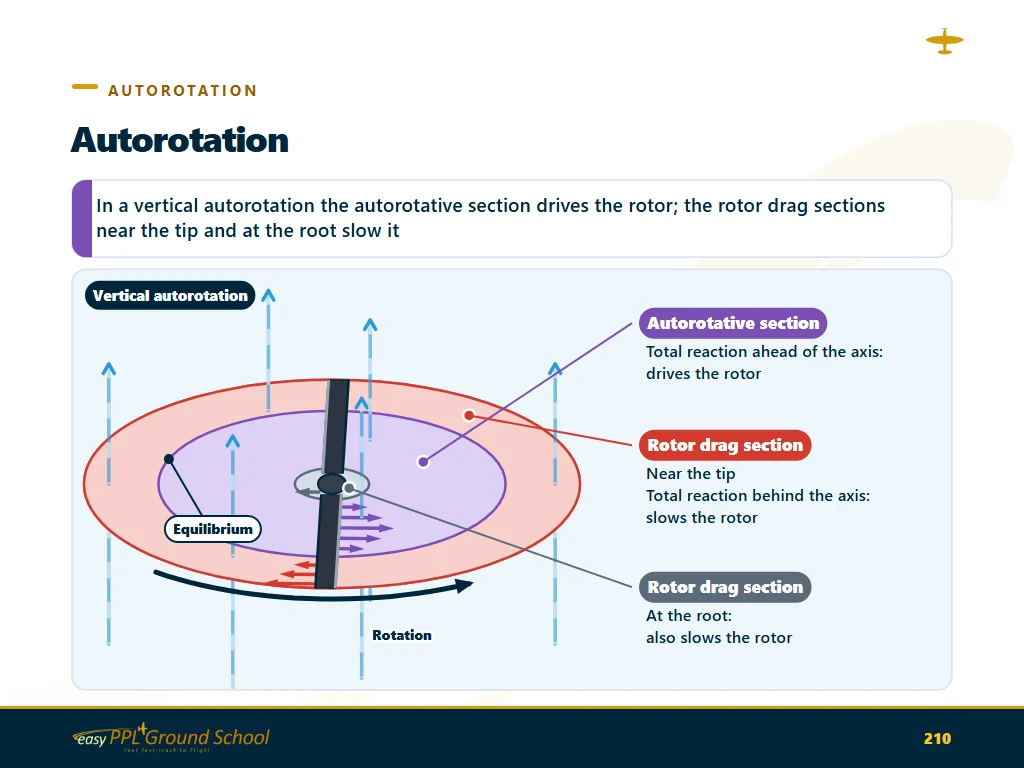
From the course · Autorotation 03Part 3
Flying the helicopter
The hover and vertical flight, moving into forward flight and back, and autorotation.
- 8Vertical Climb and DescentThe vertical climb and descent, rotor RPM limits, ground effect and the ground cushion, and recirculation.25 slides Progress Test 7
- 9TransitionFrom the hover into forward flight with translational lift, flapback and inflow roll, and back again.20 slides Progress Test 8
- 10AutorotationThe rotor turned by the airflow, the sections of the disc, rotor RPM, the flare and the height-velocity diagram.27 slides Progress Test 9
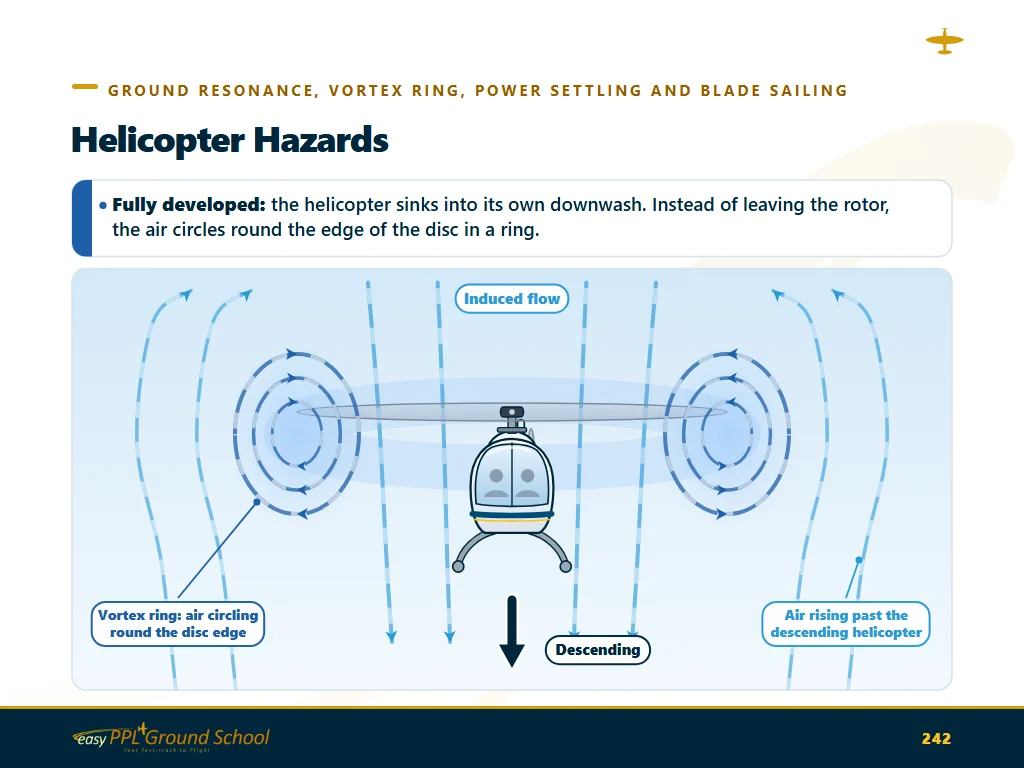
From the course · Vortex ring 04Part 4
Hazards and limits
The dangers particular to helicopters, how stable a helicopter is, and why it has a top speed.
- 11Ground Resonance, Vortex Ring, Power Settling and Blade SailingGround resonance, vortex ring, power settling, loss of tail rotor effectiveness, blade sailing and rollover.34 slides Progress Test 10
- 12StabilityStatic and dynamic stability, the aids to stability, the C of G, and control power with each rotor head.28 slides Progress Test 11
- 13Limits to High Speed FlightRetreating blade stall, compressibility at the advancing tip, mast bumping and the never-exceed speed.20 slides Progress Test 12
Drawn for this course
One helicopter, start to finish
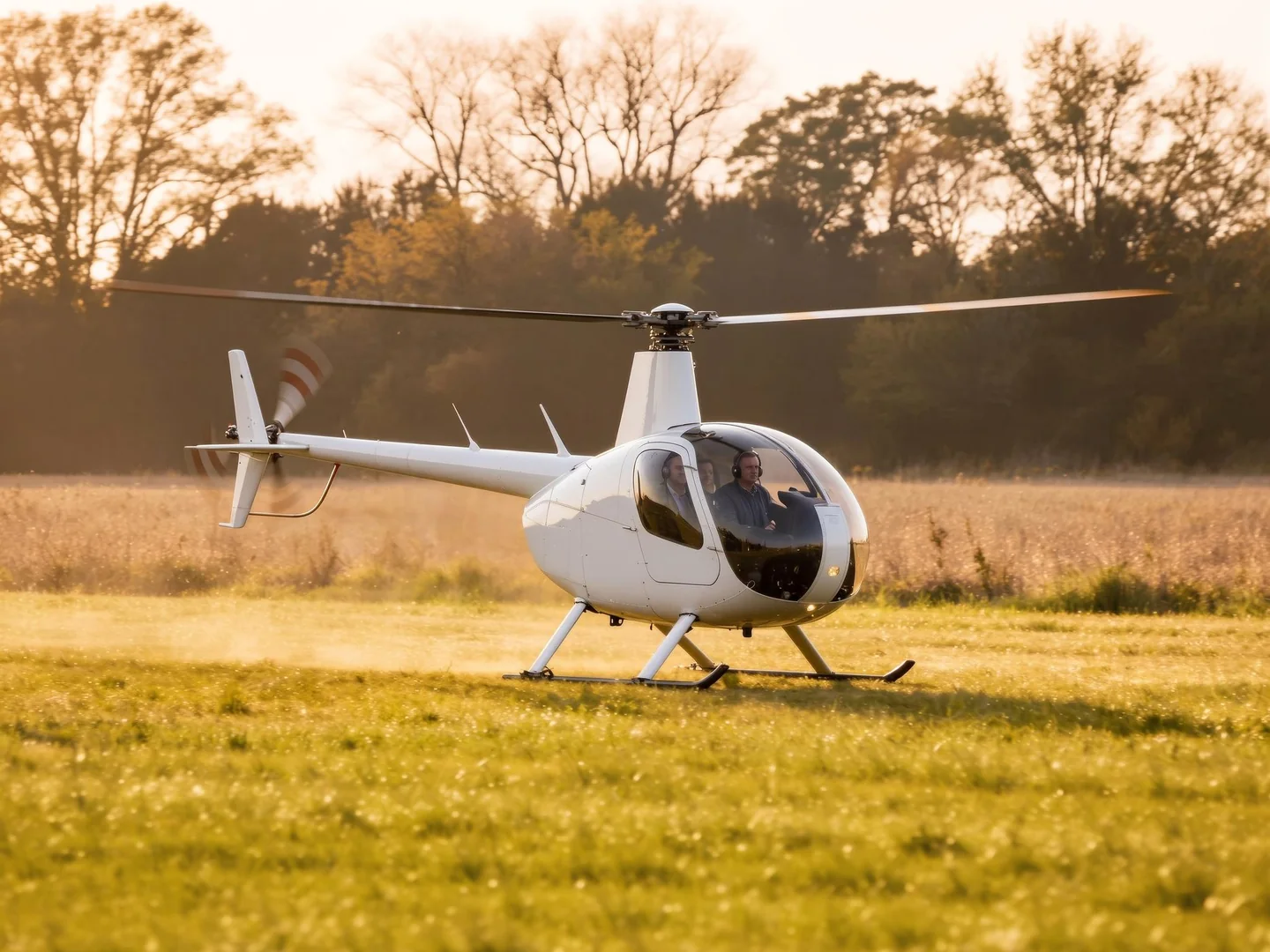
Every slide uses the same two-seat training helicopter, so you always know what you're looking at. The rotor turns, the air moves and each diagram builds up as the narrator explains it.
- Rotor aerodynamics
- Phase lag
- Autorotation
- Vortex ring
What's included
Everything you need, in one place
- 318 animated slidesEach one built up step by step while a narrator explains it, in 13 chapters.
- Classic slides tooPrefer still pictures? Switch to Classic for each slide with a short spoken summary.
- 12 progress testsCheck what you've learnt as you go, with explanations to learn from.
- Course examExam-style questions on the whole course to finish.
- Certificate of completionYours when you pass the course exam.
- Exam readiness certificateShows you're ready to sit the official exam.
- Kept up to dateUp-to-date material that stays up to date.
- Study anywhereOn your computer, tablet or phone.
Buy it now
Choose how you study
Full Course
£15.49for one month
Renew for £13.94 a month
- Every lesson in the course
- 12 progress tests
- The course exam
- 2 certificates
Test/Exam Access Only
£13.99for one month
Renew for £13.99 a month
- 12 progress tests
- The course exam
- Ideal for revision
No account needed to add to your basket: you'll register (free) at checkout, and your course opens as soon as you've paid.