
 Official differences training
CabinPressurisationDifferences Training
Official differences training is required before you fly an aeroplane with a pressurised cabin. It covers both theory and training in the aeroplane with an instructor.
- animated slides
- 168
- animated slides
- chapters
- 11
- chapters
- and a course exam
- 11 tests
- and a course exam
Free preview
A decompression over high ground
The cabin decompresses at 25,000 ft, with mountains under the route. Watch where heading straight down to 10,000 ft would take you, then the two safe ways out: hold the minimum safe altitude on oxygen until you're past the high ground, or turn back towards lower ground. This is slide 7 of chapter 11, In-flight Failures and Emergencies, recorded as it plays in the course. Turn your sound on to hear the narration.
Cabin Pressurisation Differences Training· Chapter 11 · Slide 71:05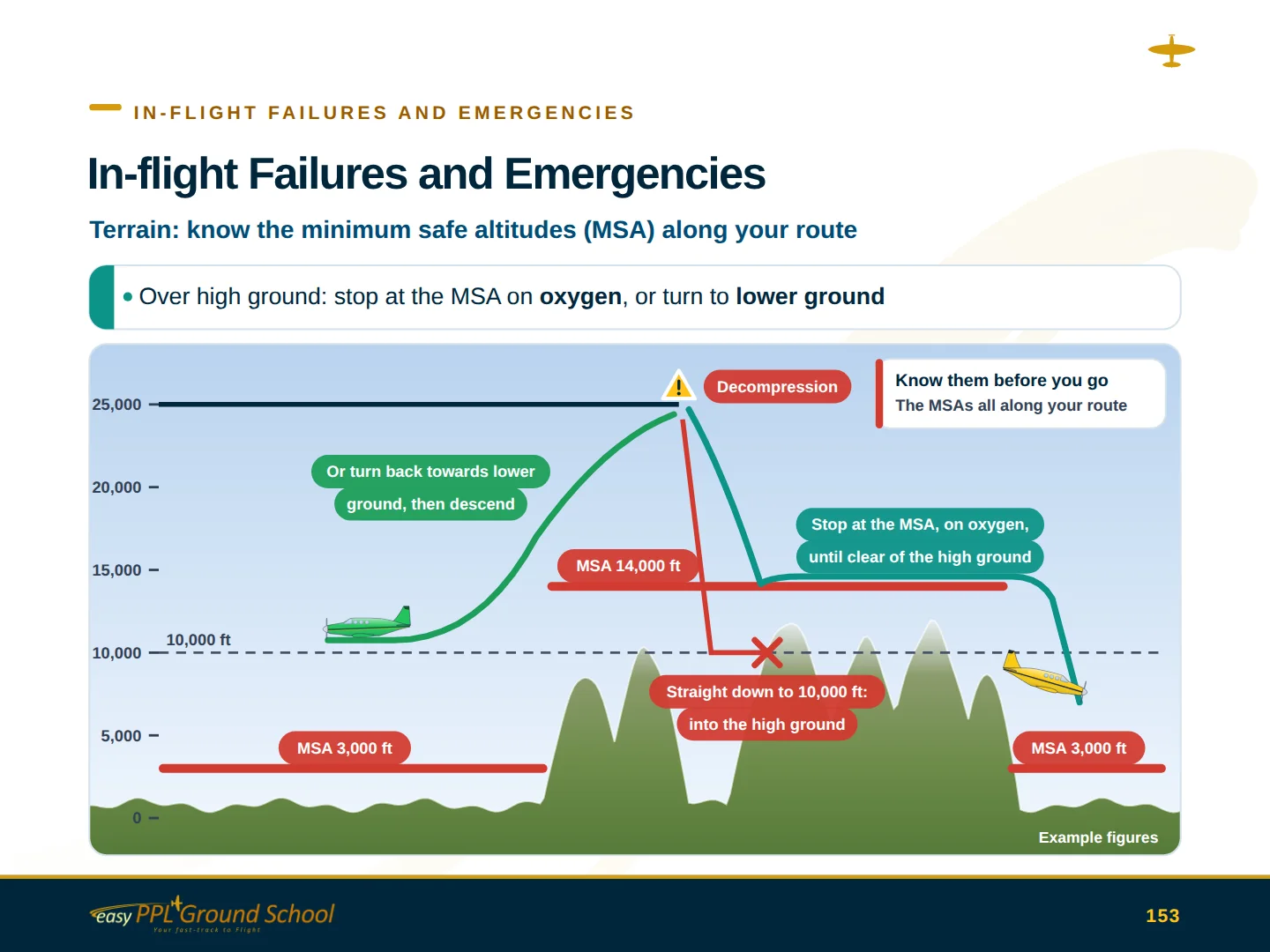
- Every slide is animatedEach step builds up as it's explained, at a pace you can follow.
- Three narratorsThree voices take turns to teach the animated slides.
- Classic slides tooSwitch to Classic to see each slide as a still picture with a short spoken summary.
The course
What you'll learn
This course teaches the theory, following the CAA's cabin pressurisation and oxygen systems syllabus heading by heading: how pressurisation works and what it does for performance, how the aeroplane is built to hold the pressure, the system and its heating and air conditioning, its limitations, hypoxia and the time of useful consciousness, oxygen systems, the airspace, ratings, rules, weather and navigation at high level, normal operation in every phase of flight, and failures, decompression and the emergency descent. Your training with an instructor then puts it into practice.
Every chapter ends with a progress test, and the course ends with a course exam. The course is for single-engine aeroplanes.
To prove you have completed the course, after you have passed our on-line exam you will be issued with a Course Completion Certificate.
What's new
What changes when the cabin is pressurised
You already know how to fly. This course teaches what a pressurised aeroplane adds, in four areas.
 01
The system
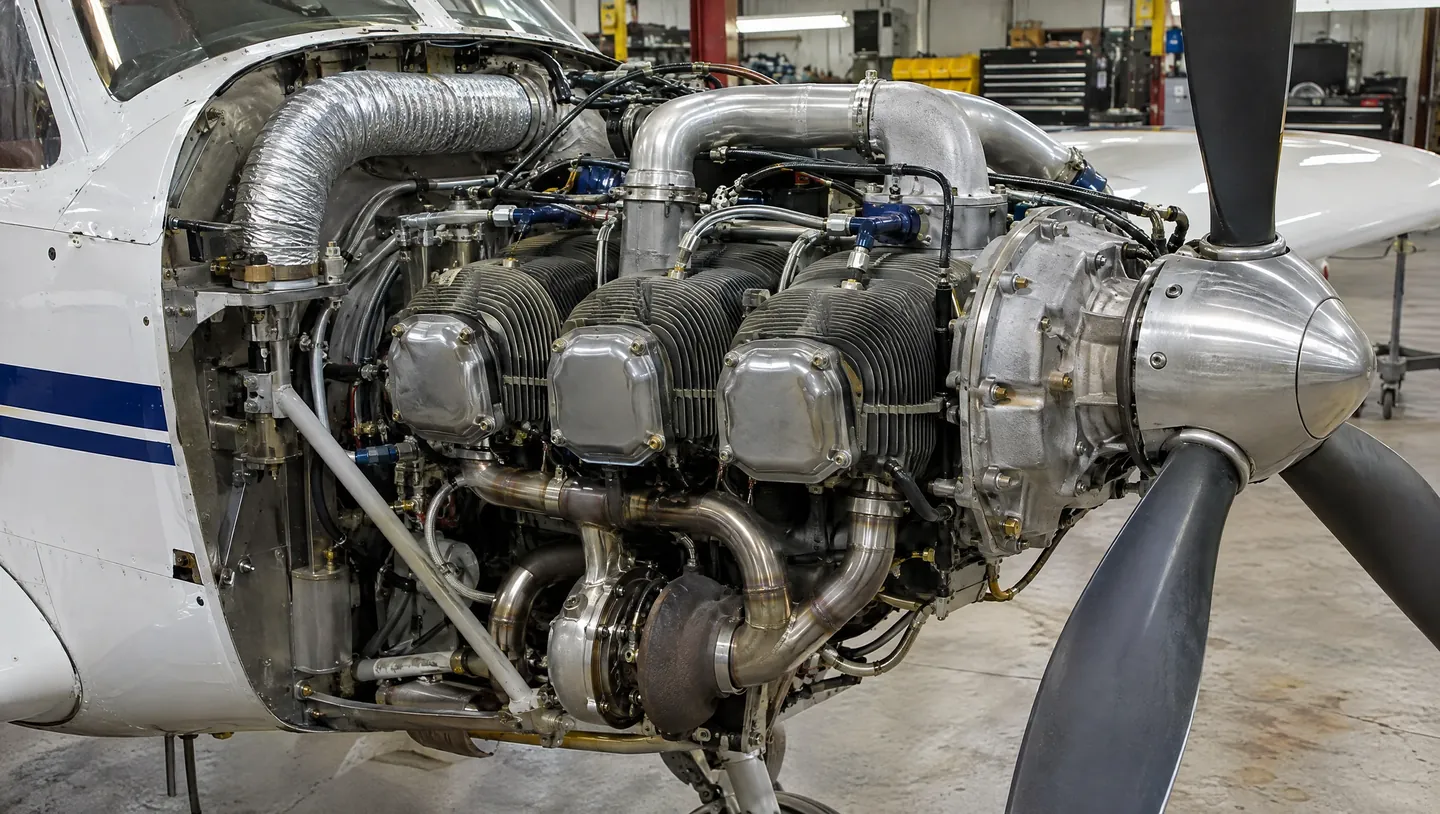
Air, usually from the turbochargers, is pumped into a sealed cabin and let out through an outflow valve. You'll learn the pressure vessel, the controller, the safety and dump valves, heating and air conditioning, the limits your flight manual sets, and how to set and watch it all from the pre-flight checks to landing.
Chapters 2 to 5 and 10
 02
The human side
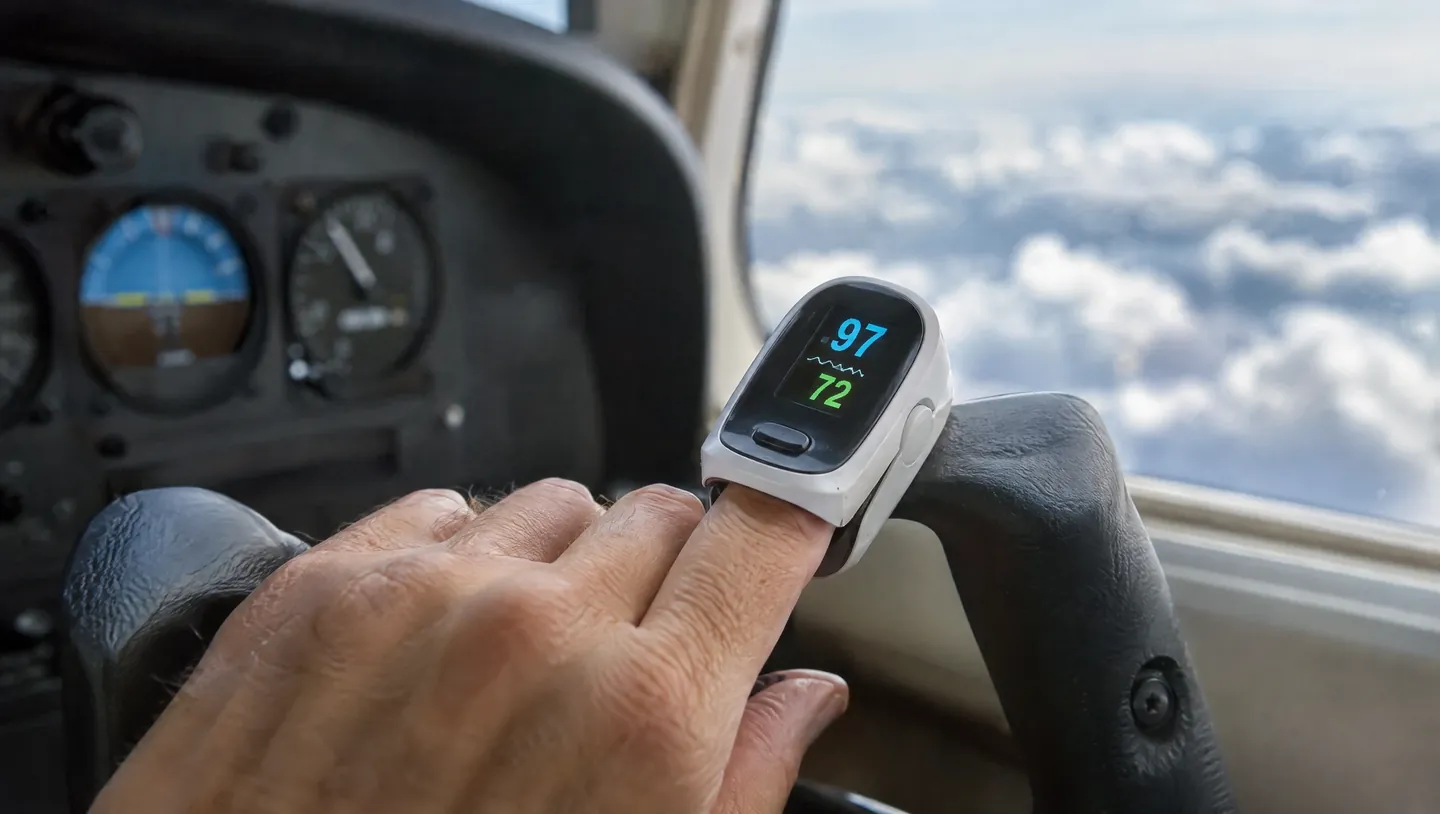
Hypoxia comes on unnoticed, and often feels pleasant. You'll learn its symptoms, the time of useful consciousness, trapped gas and decompression sickness, and the oxygen system, masks and pulse oximeter you'll use.
Chapters 6 and 7
 03
High altitude
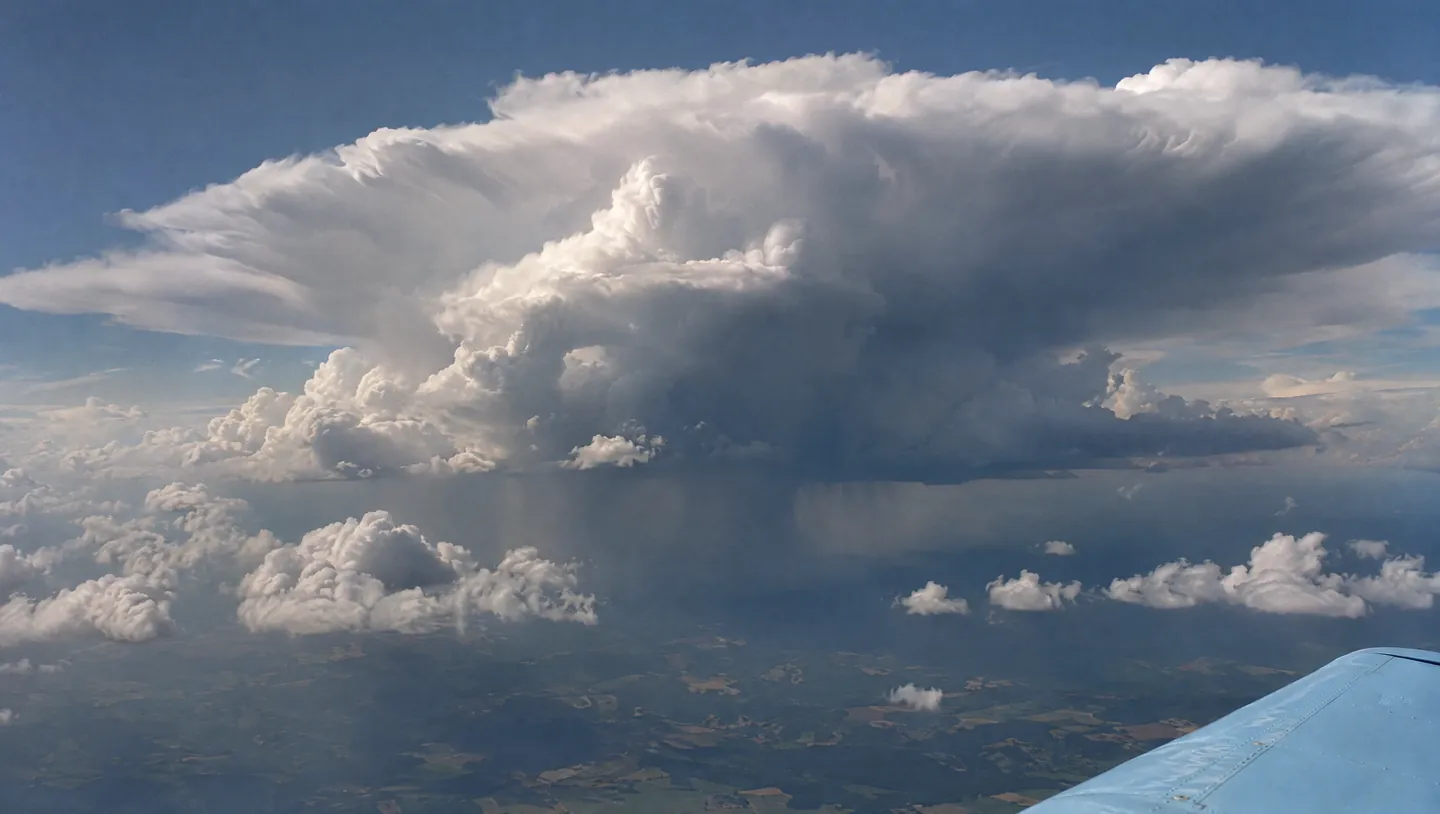
Above FL195 all UK airspace is Class C, and the weather is different up there: about −35 °C at FL250, jet streams and clear air turbulence not far above, icing in the climb and descent, and thunderstorm tops far above you. You'll learn the airspace, privileges, rules, forecasts and navigation.
Chapters 8 and 9
 04
Emergencies
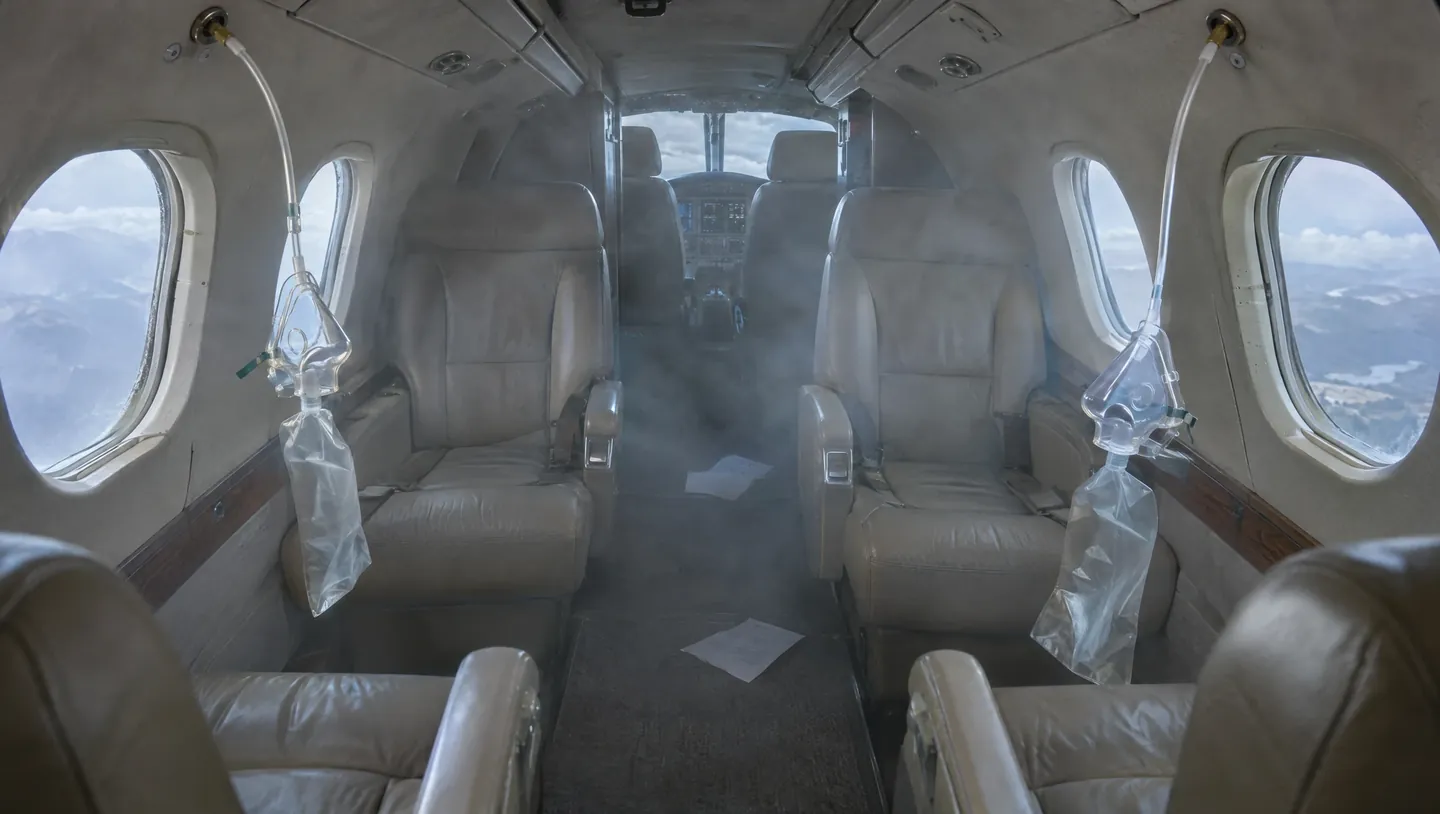
A decompression can be explosive, rapid, or so slow you don't notice it. You'll learn how to recognise one, why your own mask goes on first, how to fly the emergency descent with the terrain and ATC in mind, and what to do when other parts of the system fail.
Chapter 11
The difference
Two altitudes at once
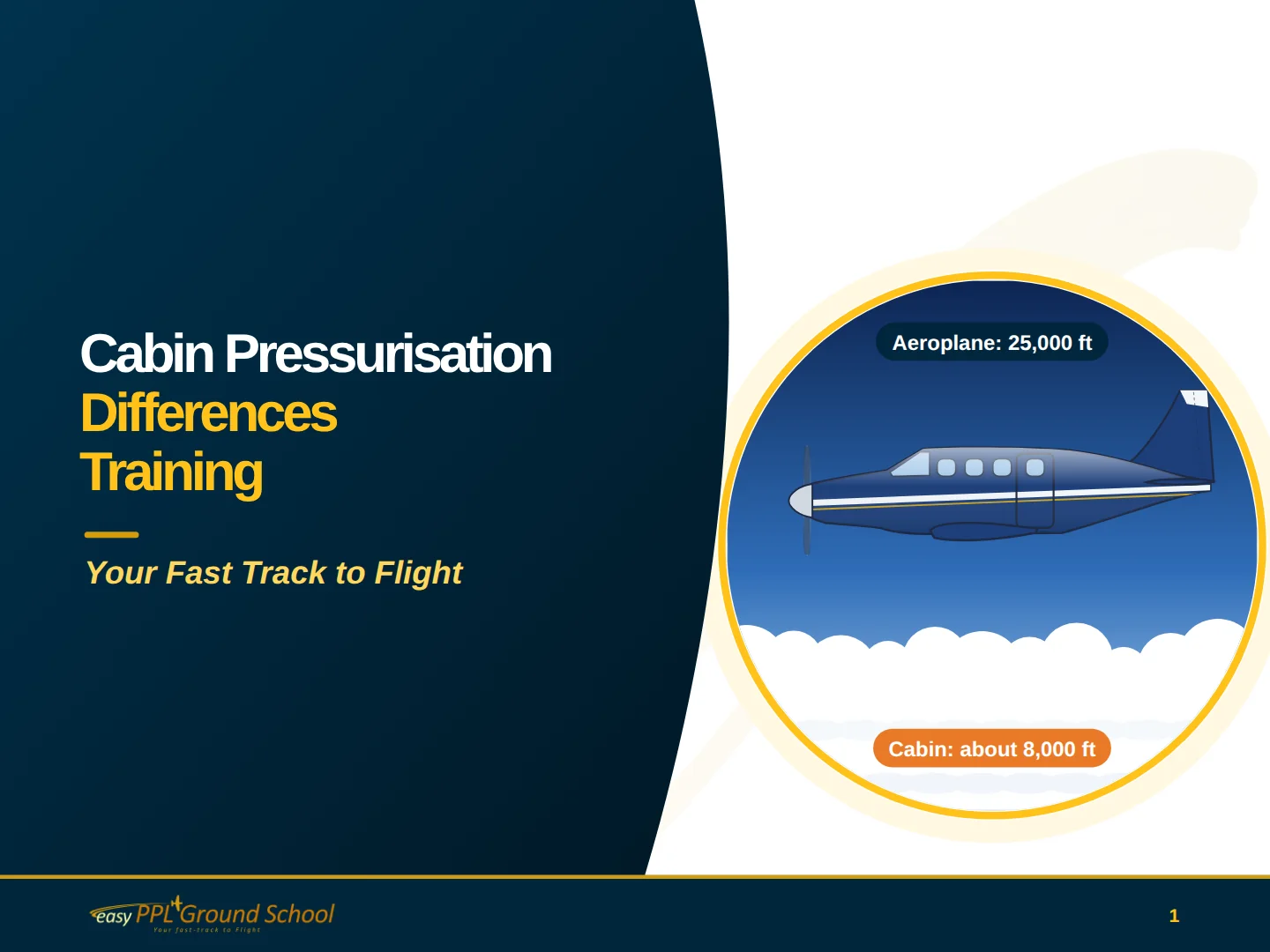
In the aeroplanes you fly now, the cabin is at whatever altitude the aeroplane is. Pressurise it, by pumping air into a sealed cabin faster than it's let out, and the two part company: at 25,000 ft the cabin can be held at about 8,000 ft, where everyone on board breathes normally without masks.
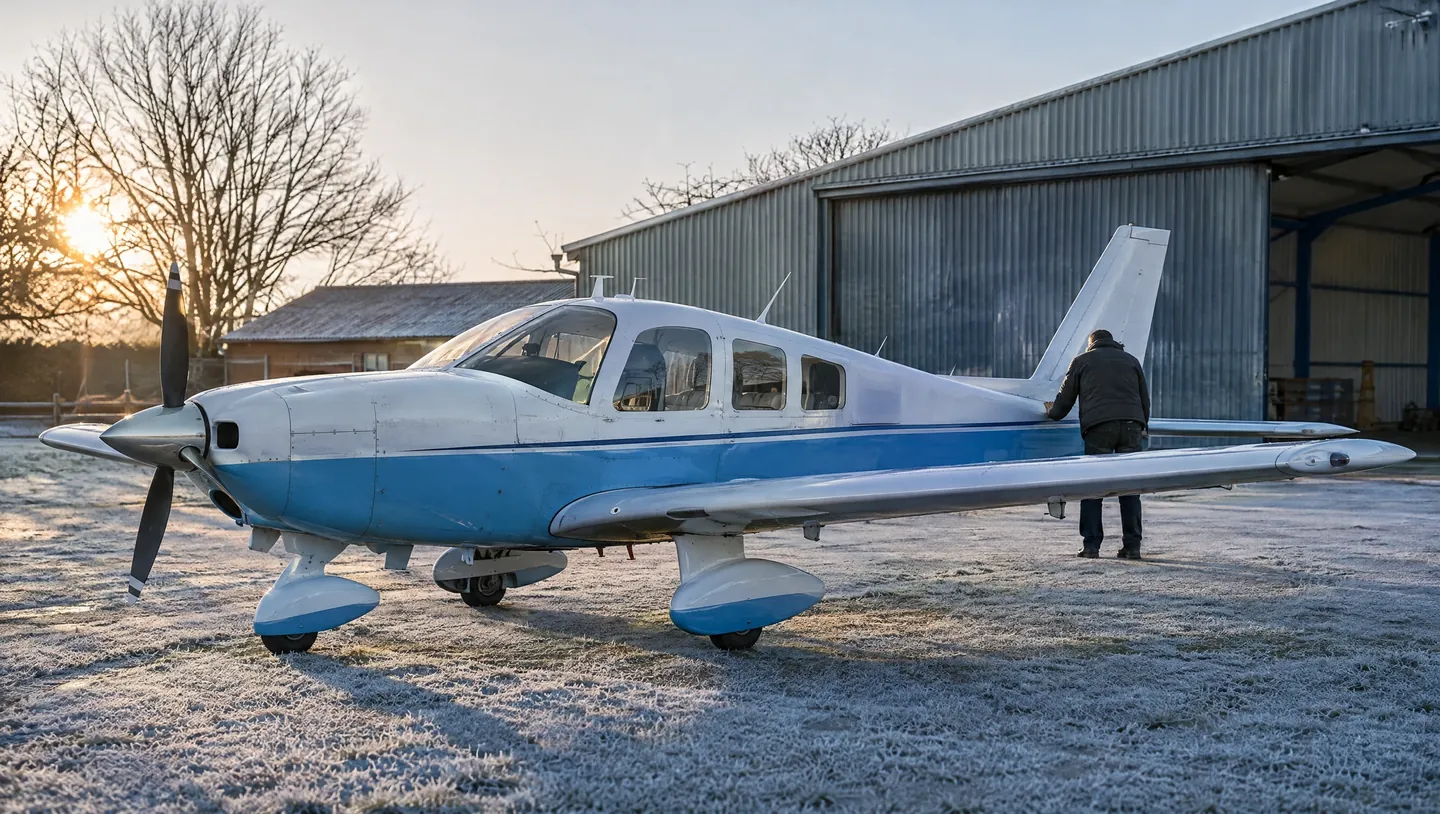
- Aeroplane
- 8,000 ft
- Cabin
- 8,000 ft
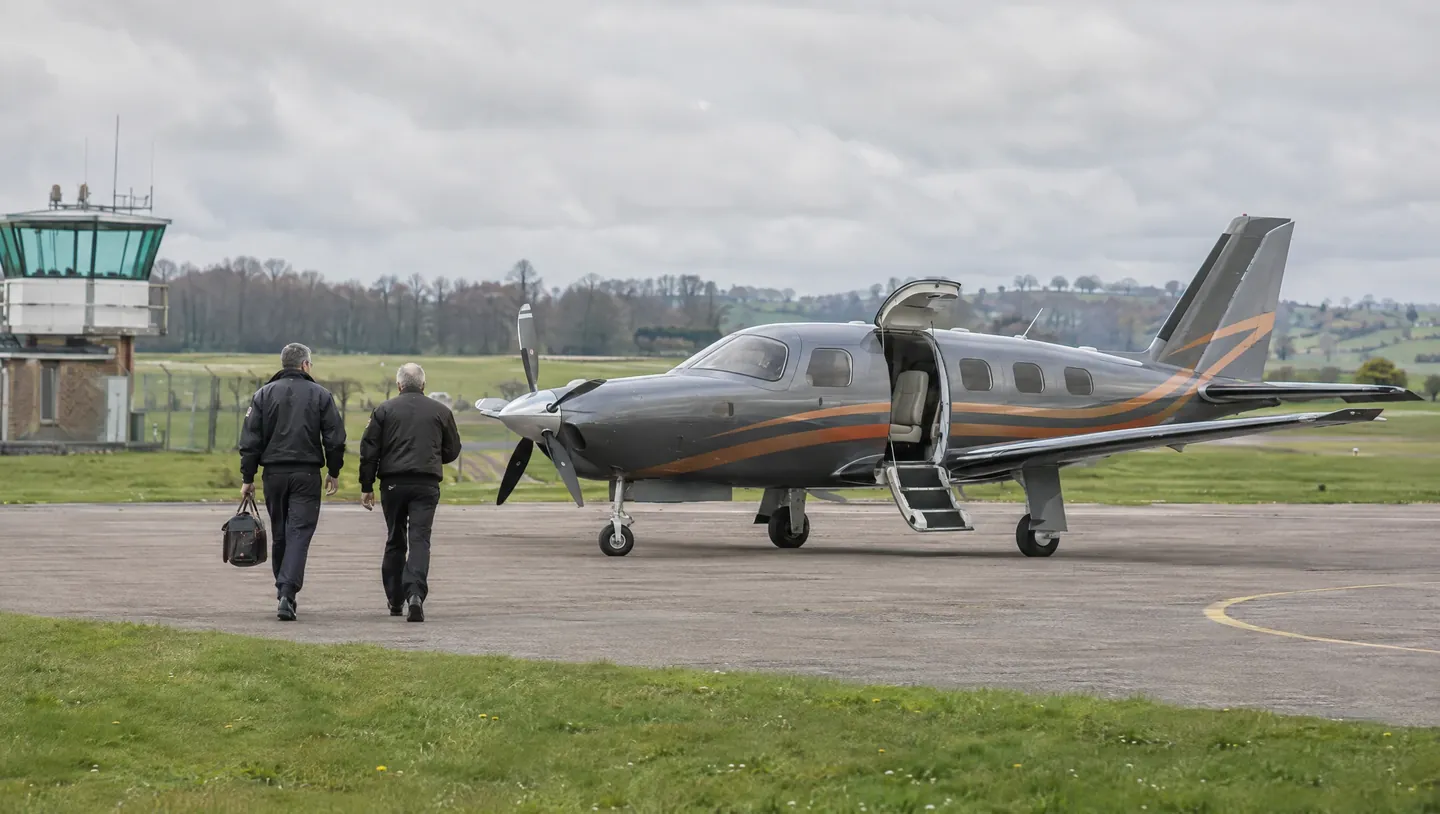
- Aeroplane
- 25,000 ft
- Cabin
- 8,000 ft
- 5.5 psiA typical maximum differential: about 790 lb on every square foot of the cabin
- −34.5 °COutside at FL250, in the standard atmosphere
- 3 to 5 minOf useful consciousness at 25,000 ft, and about half that after a rapid decompression
- 45 nmA glide from 25,000 ft above the ground at 11 to 1, if the engine stops
Course contents
Four parts, 11 chapters
The course follows the CAA's cabin pressurisation and oxygen systems syllabus heading by heading, for single-engine aeroplanes. Every chapter ends with a progress test.
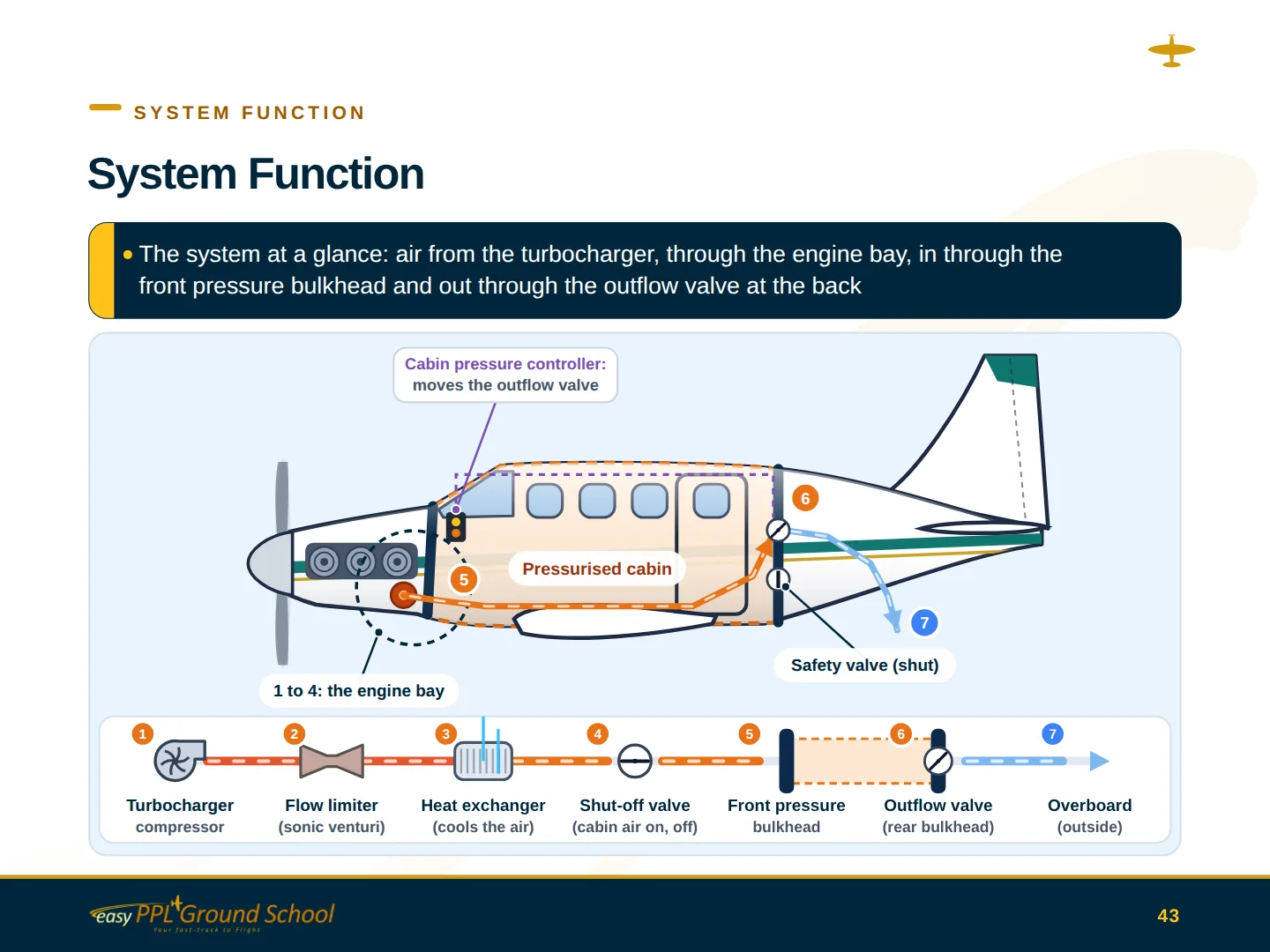
From the course · The system at a glance 01Part 1
How it works
What a pressurised aeroplane is and why the rules ask for training, then the principle, the pressure vessel and the system itself.
- 1IntroductionWhat a pressurised aeroplane is, why the rules ask for training, the syllabus at a glance, how the training is done and recorded, and the aeroplanes in this course.14 slides Progress Test 1
- 2Principle and Effect on PerformanceHow the air thins with height, why we pressurise, cabin altitude and differential pressure, the pressurisation schedule, and what it does for performance, with its costs.14 slides Progress Test 2
- 3ConstructionThe pressure vessel and the loads on it, why round shapes, windows, doors and seals, sealing everything else, fatigue, and inspecting it before flight.12 slides Progress Test 3
- 4System FunctionAir in and air out, where the air comes from, the outflow valve and the controller, safety and negative-pressure relief, dump and the ground switch, the instruments, heating and air conditioning.15 slides Progress Test 4
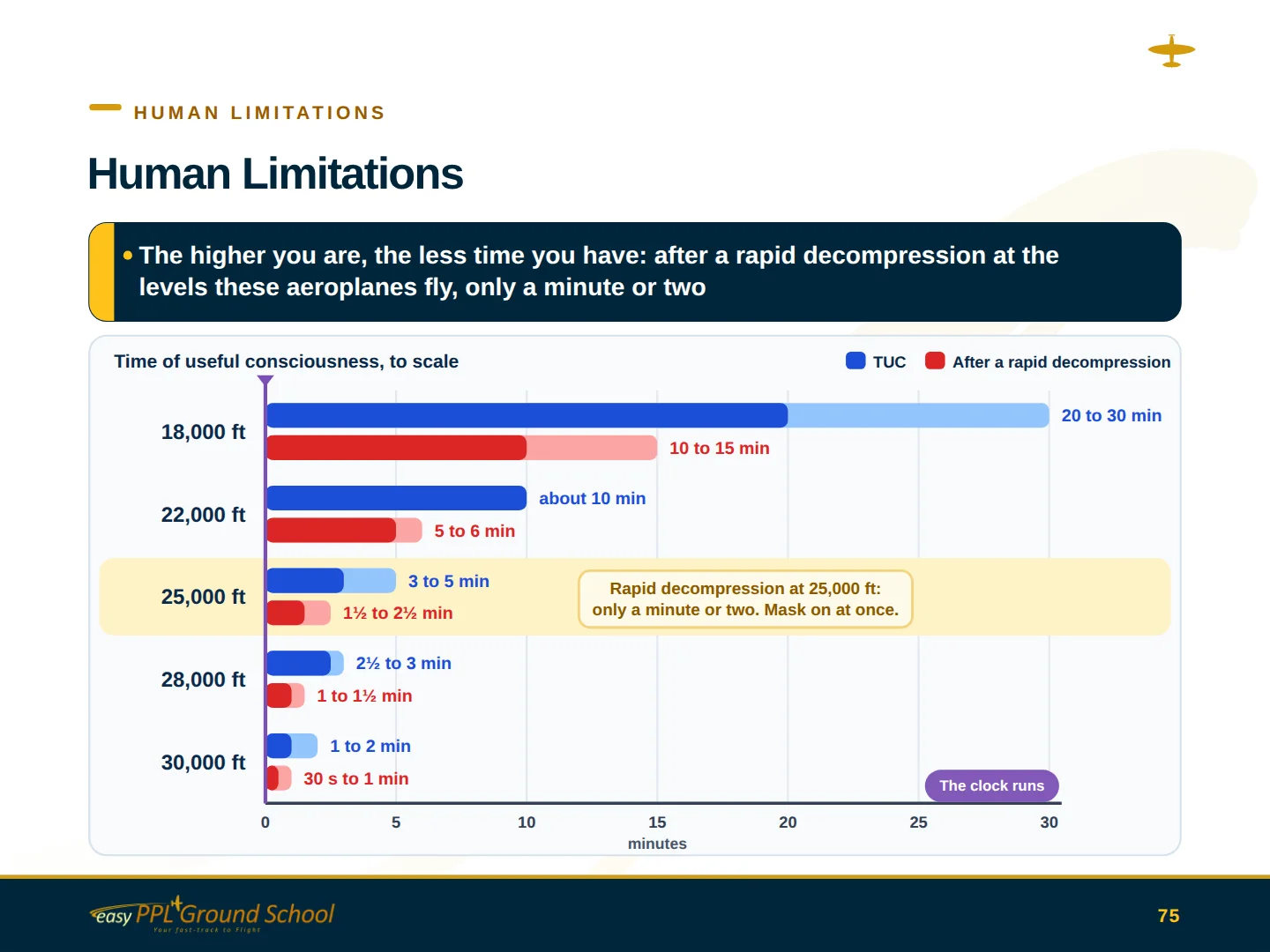
From the course · Time of useful consciousness 02Part 2
Its limits, and yours
The limits your flight manual sets, what altitude does to the body, and the oxygen system that backs it all up.
- 5Systems LimitationsWhere the limits are, the maximum differential and operating altitude, landing unpressurised, the negative differential, flying with the system inoperative, defects, engine power and oxygen.13 slides Progress Test 5
- 6Human LimitationsOxygen pressure and the body, hypoxia's types and symptoms, the time of useful consciousness, who is at greater risk, hyperventilation, trapped gas, decompression sickness, and diving.17 slides Progress Test 6
- 7Oxygen SystemsWhy a pressurised aeroplane carries oxygen, storage, capacity and duration, the system, masks and cannulas, passengers' oxygen, pre-flight checks, oxygen and fire, and the pulse oximeter.15 slides Progress Test 7
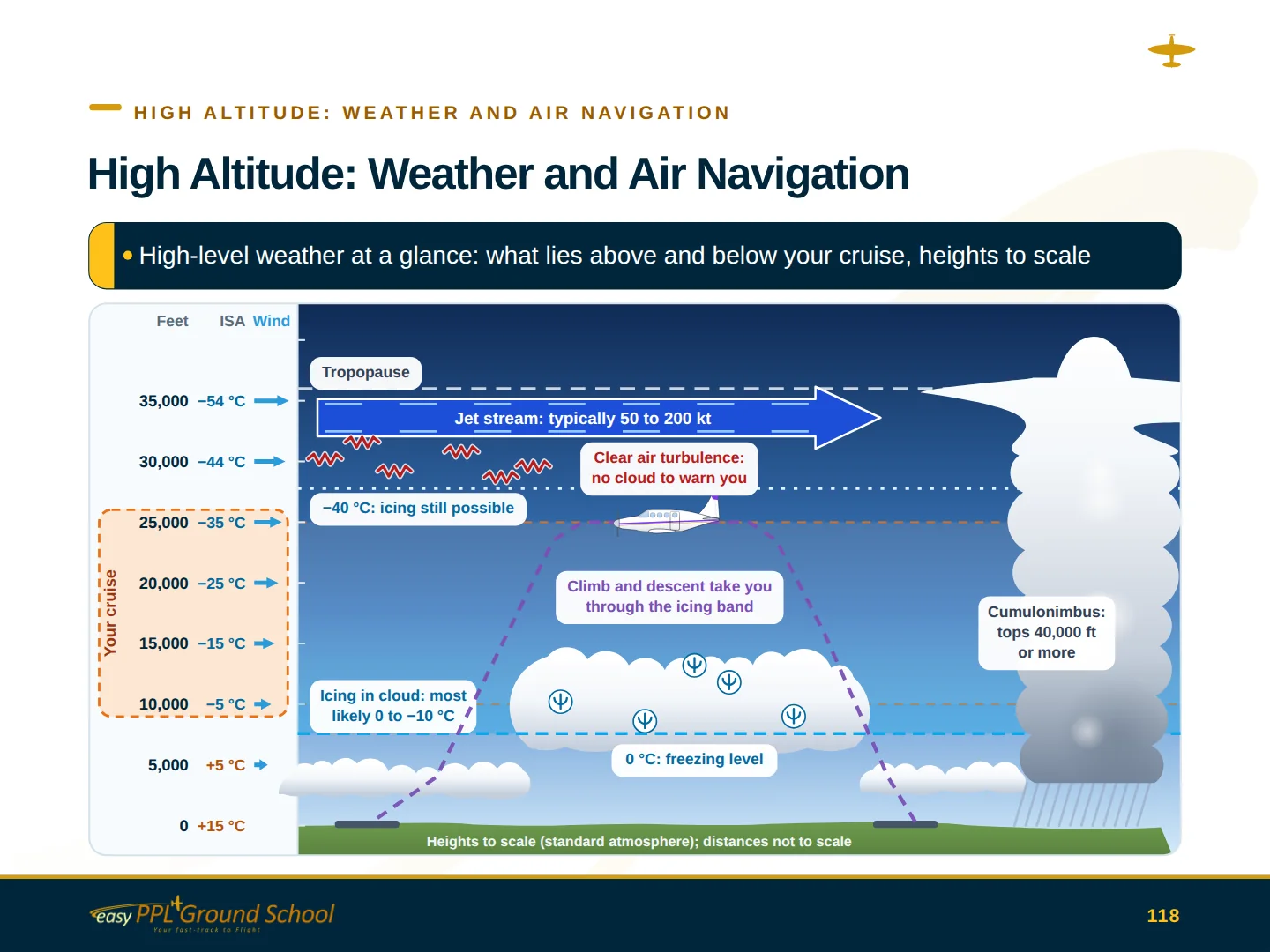
From the course · High-level weather 03Part 3
Up at high level
The airspace, privileges and rules above the levels you fly now, and the weather and navigation up there.
- 8High Altitude: Airspace, Privileges and RulesWhere you'll be flying, UK airspace by level, controlled airspace, licence and rating privileges, cruising levels, the transition altitude, VMC, speed and VFR limits, and the oxygen rules.16 slides Progress Test 8
- 9High Altitude: Weather and Air NavigationHigh-level weather at a glance, temperature and cold soak, winds aloft and jet streams, turbulence, icing, thunderstorms, the forecasts for these levels, and RNAV and RNP.15 slides Progress Test 9
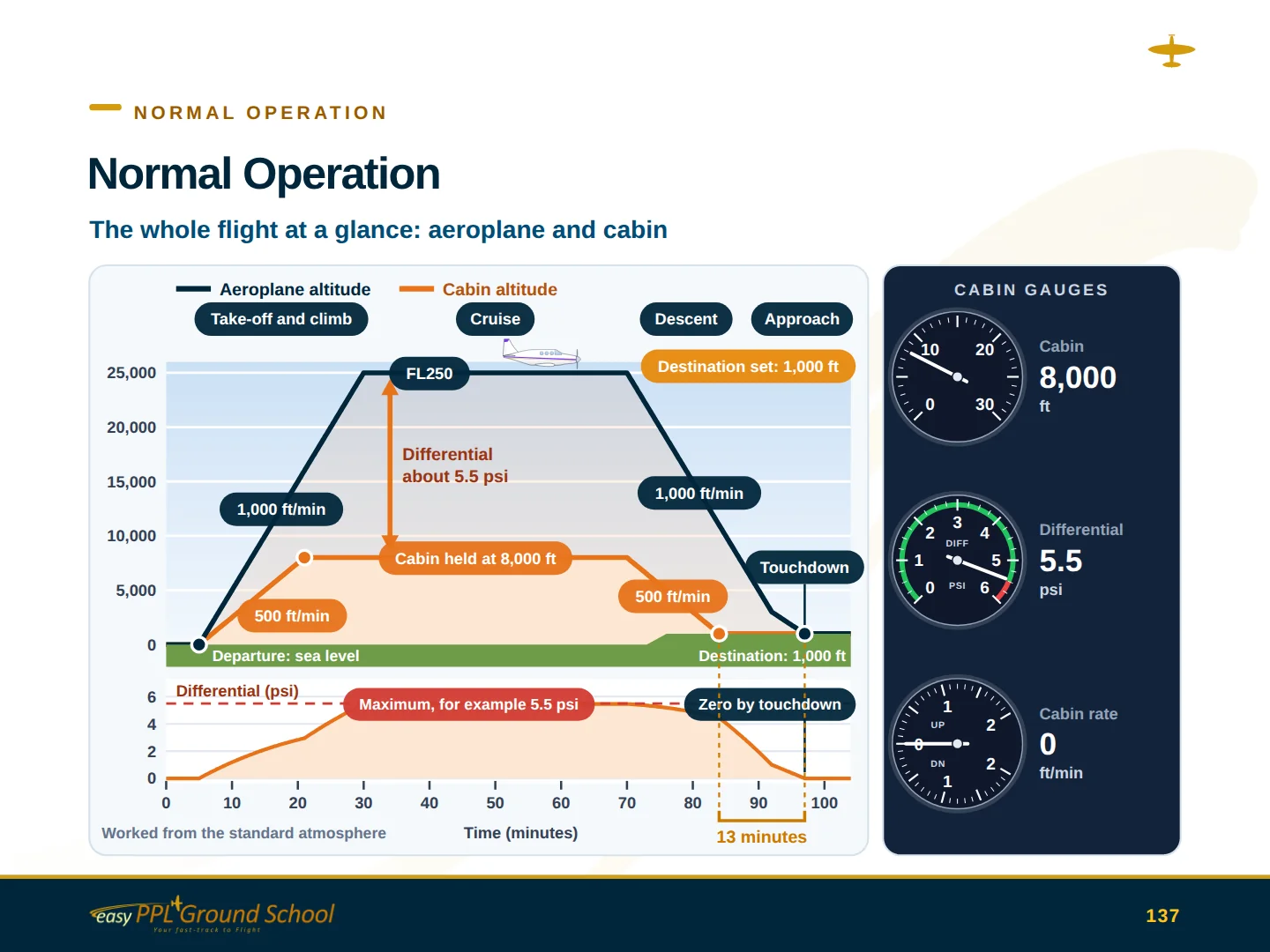
From the course · The whole flight at a glance 04Part 4
Flying it
Setting and watching the system from the pre-flight checks to landing, and what to do when it fails.
- 10Normal OperationPlanning, the pre-flight checks outside and in, briefing passengers, the take-off, climb, cruise, descent, approach and landing, and after the flight.15 slides Progress Test 10
- 11In-flight Failures and EmergenciesThe three kinds of decompression, recognising one, oxygen first, the emergency descent, terrain and ATC, other failures, engine failure, a cracked window or door seal, and smoke and fumes.15 slides Progress Test 11
- Step 1Learn it hereThe theory of every syllabus heading, with a progress test after each chapter.
- Step 2Train with an instructorIn the aeroplane or an appropriate training device, with an instructor.
- Step 3Logbook signedYour instructor signs your logbook, listing the features covered.
The photographs
Every one a different scene
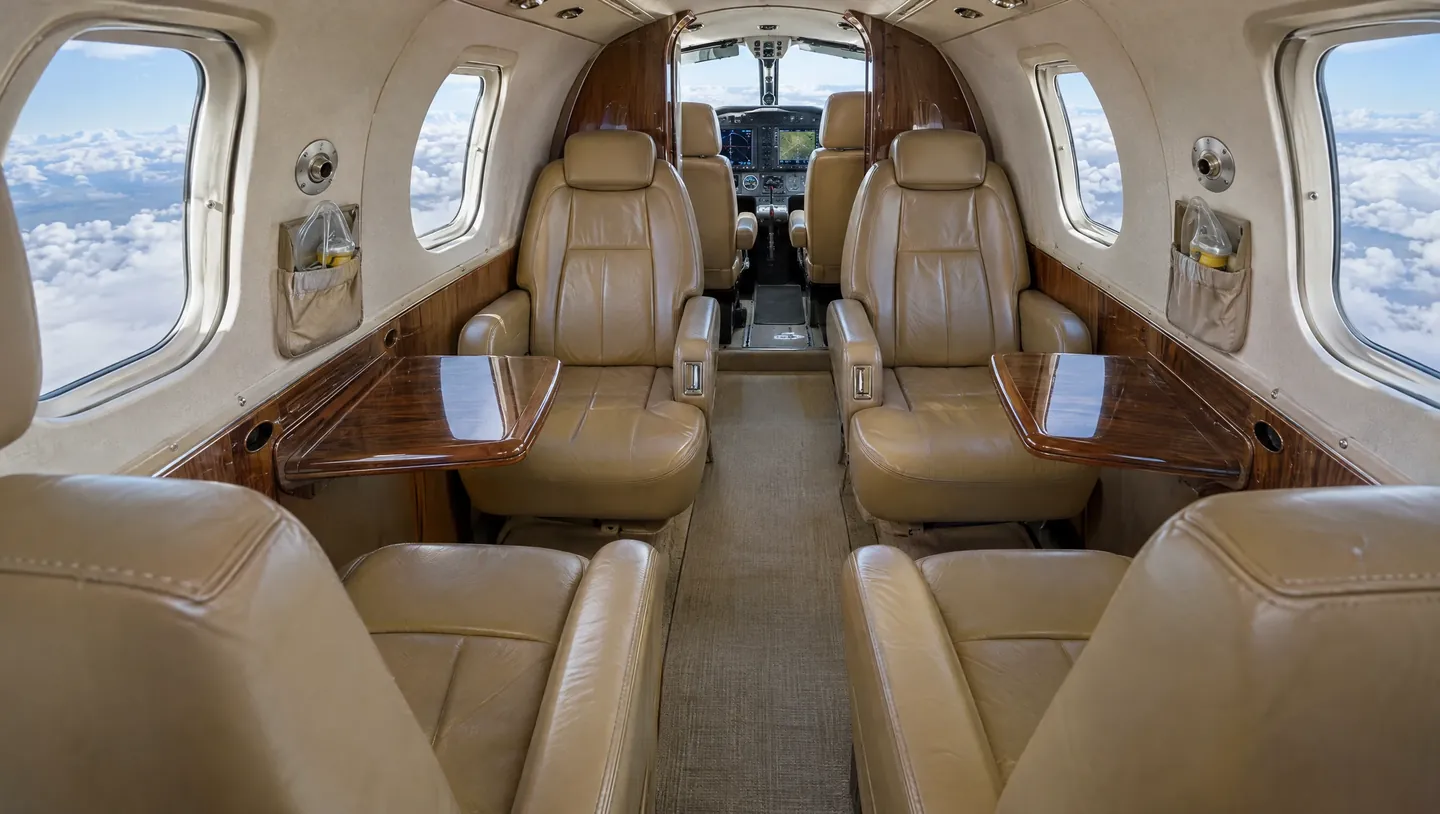
Each with its own colour scheme and setting: over the Alps and the chalk cliffs, above valley fog, on a wet apron, in a hangar at night.
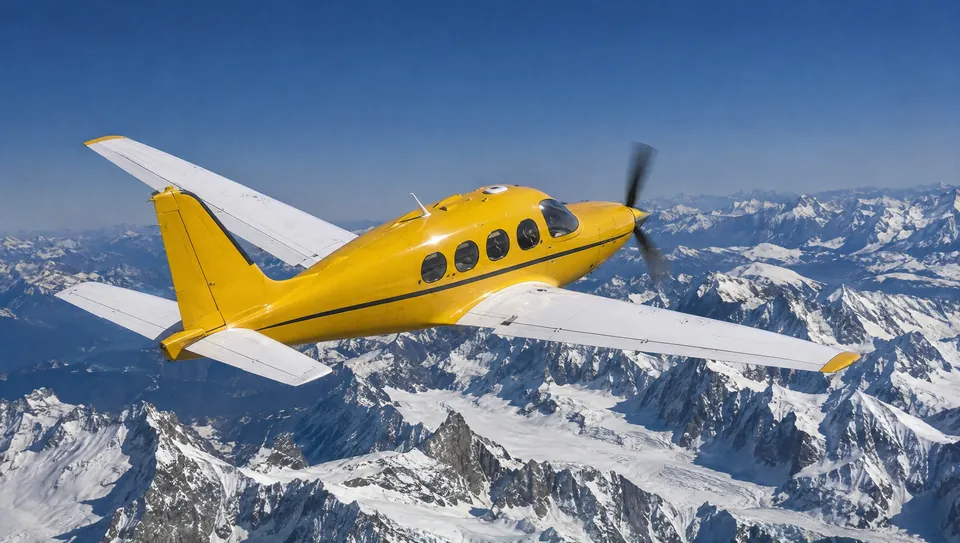
Over the Alps 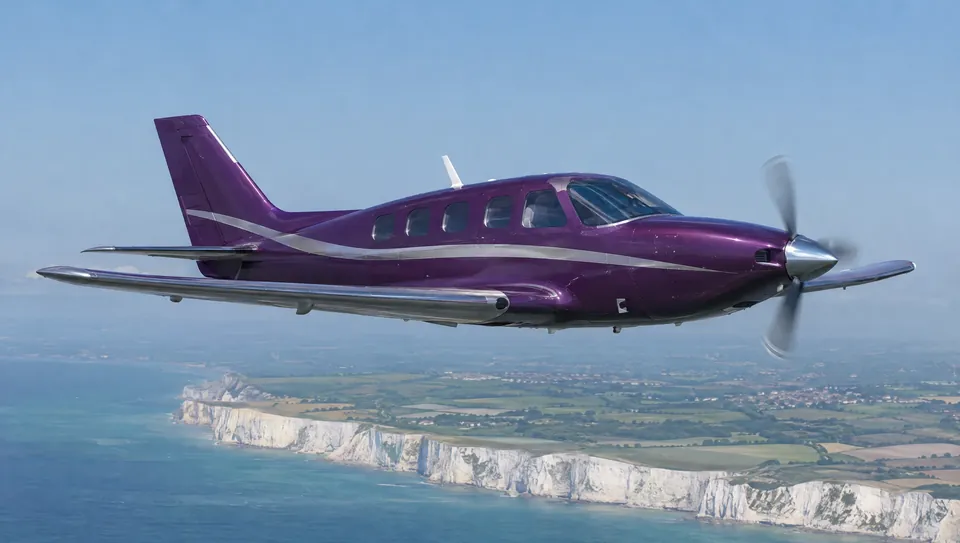
Chalk cliffs 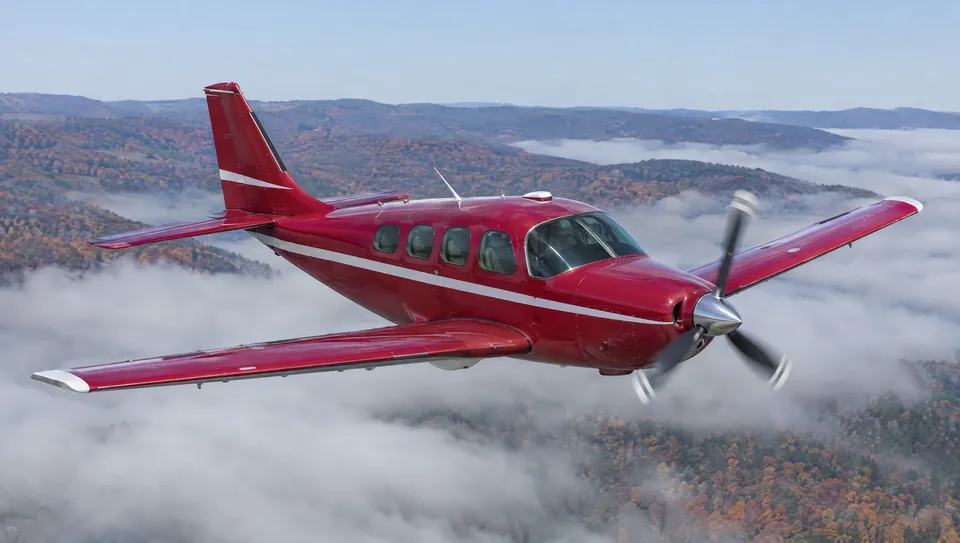
Above valley fog 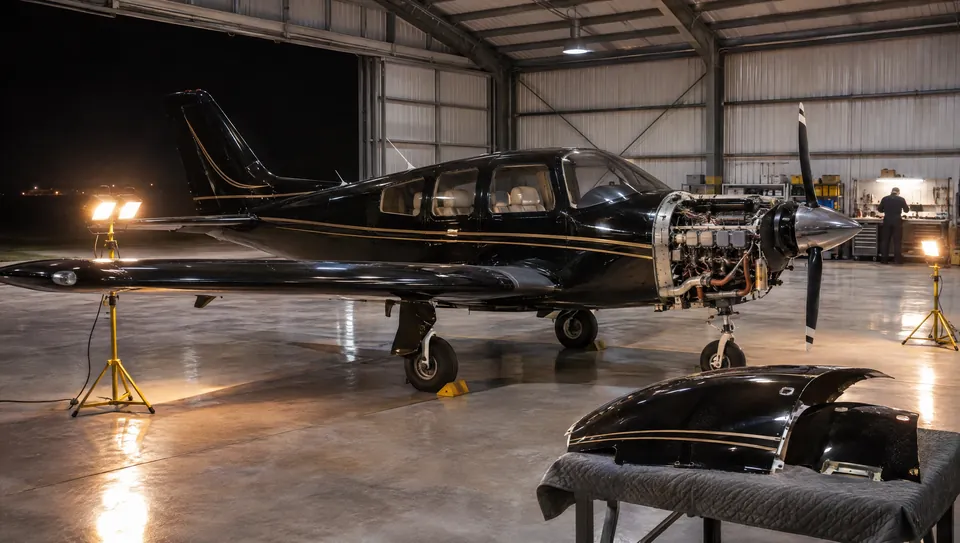
In the hangar 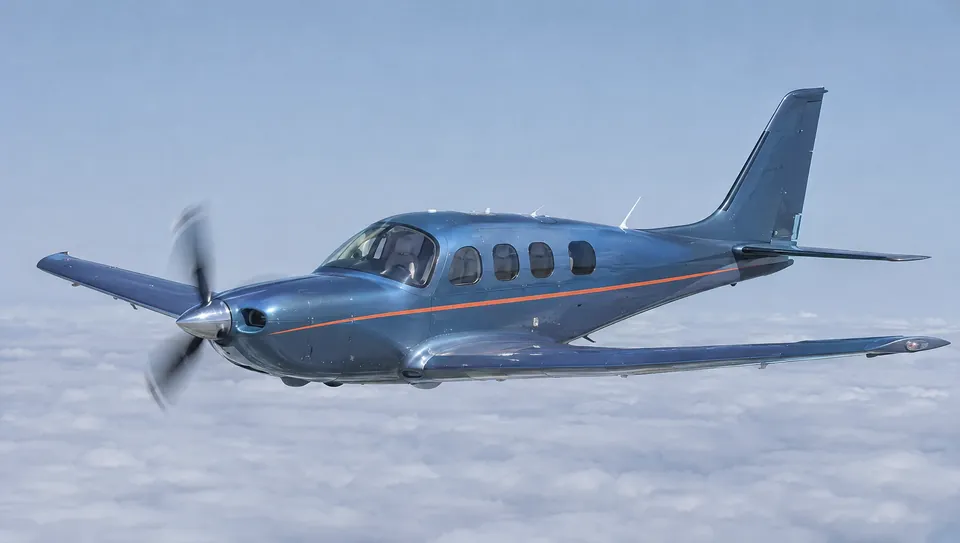
Above the cloud 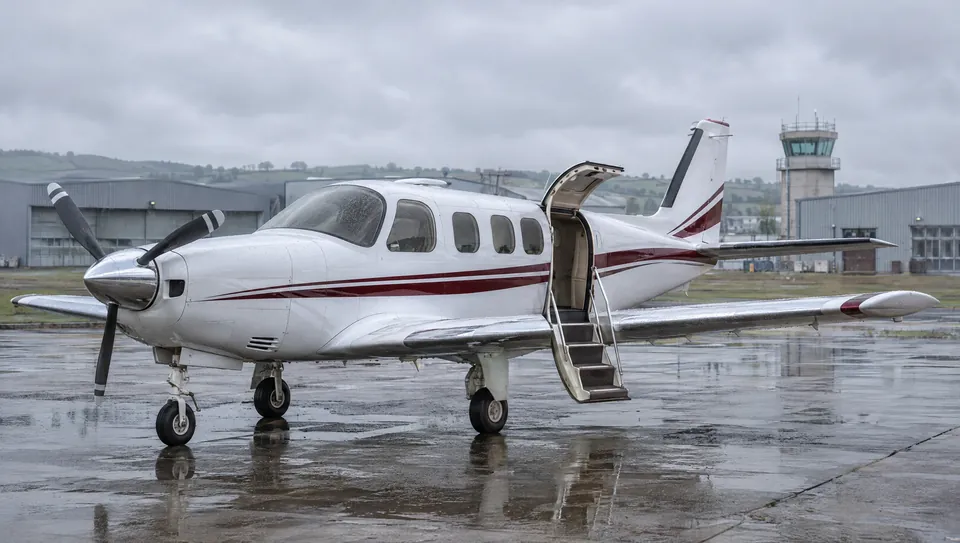
A wet apron 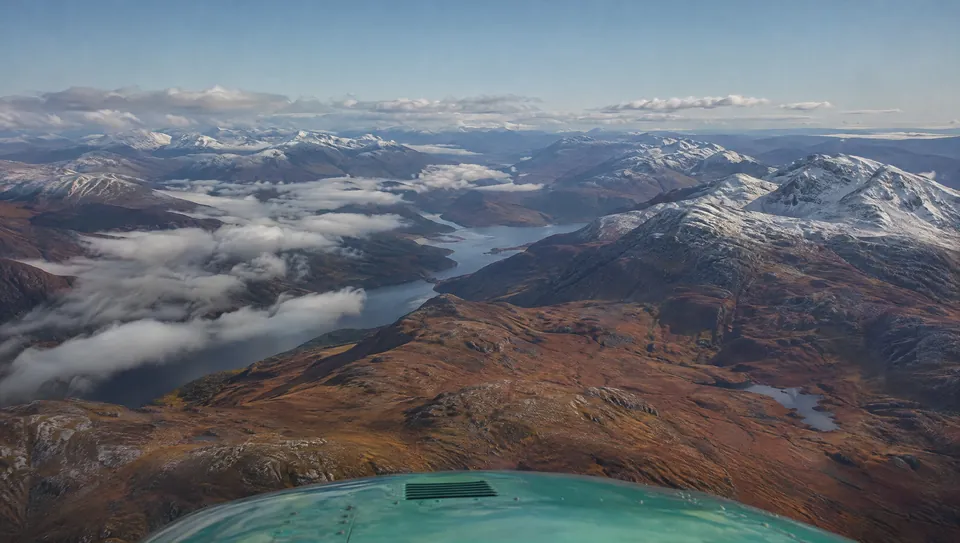
The Highlands 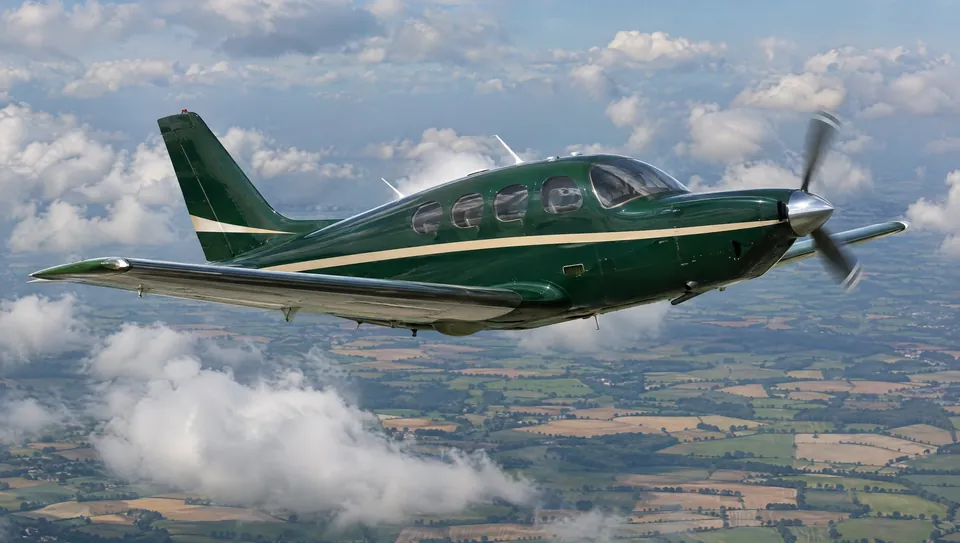
Climbing out 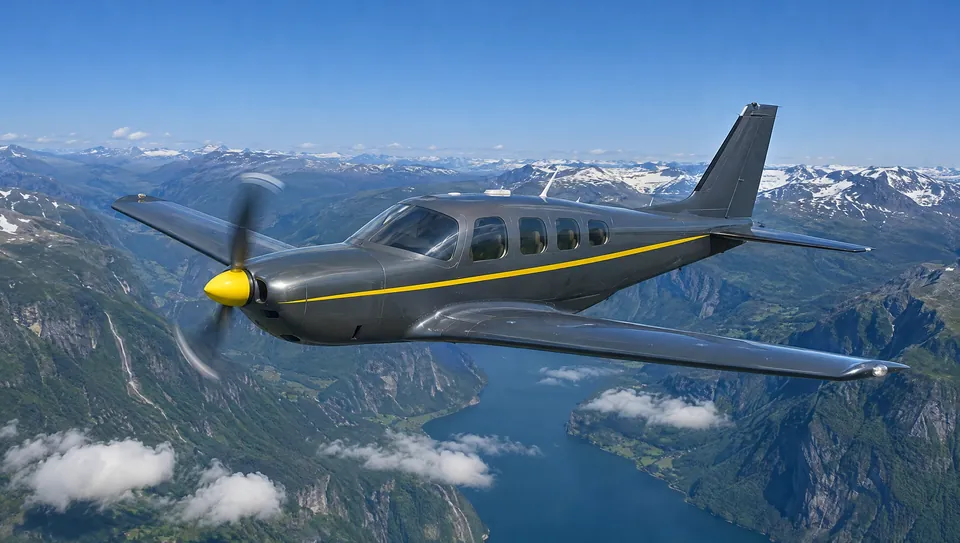
Over a fjord 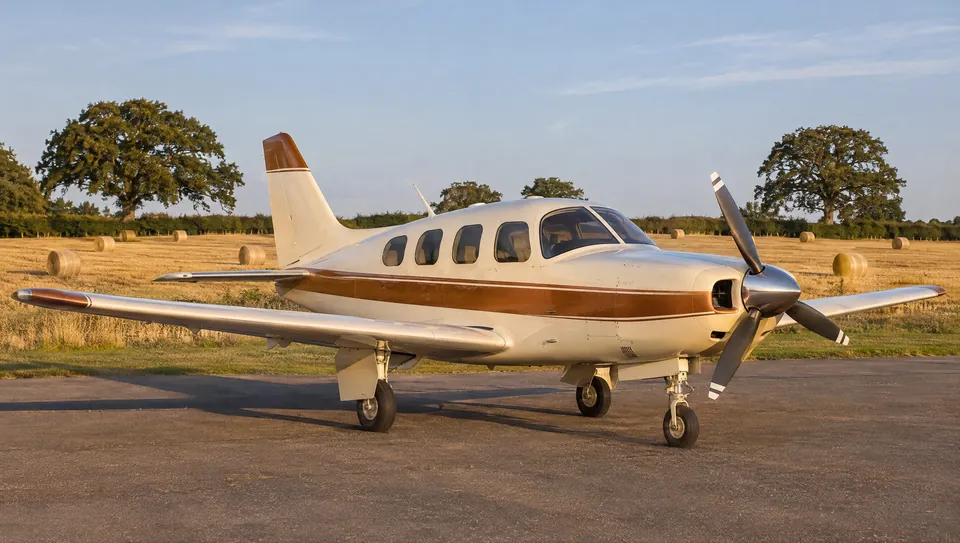
A summer airstrip 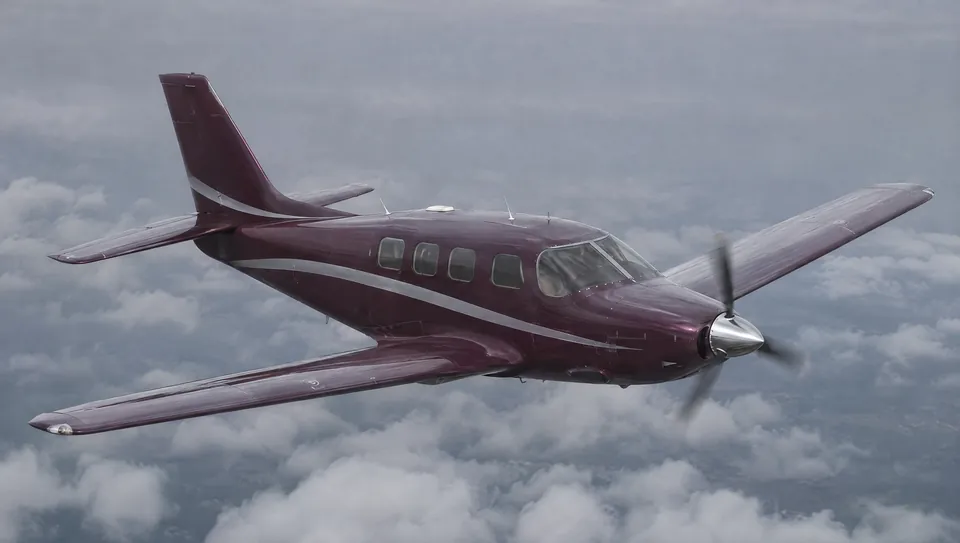
In the cruise 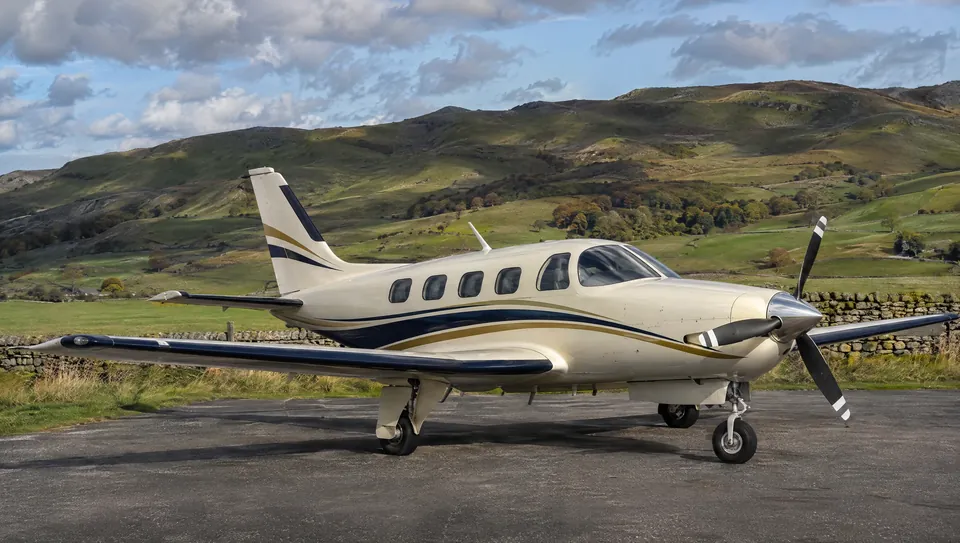
The Welsh hills
Inside the course
Pressurisation you can see
Real slides from the course. Each one builds up step by step while the narrators explain it, with the figures worked from the standard atmosphere.
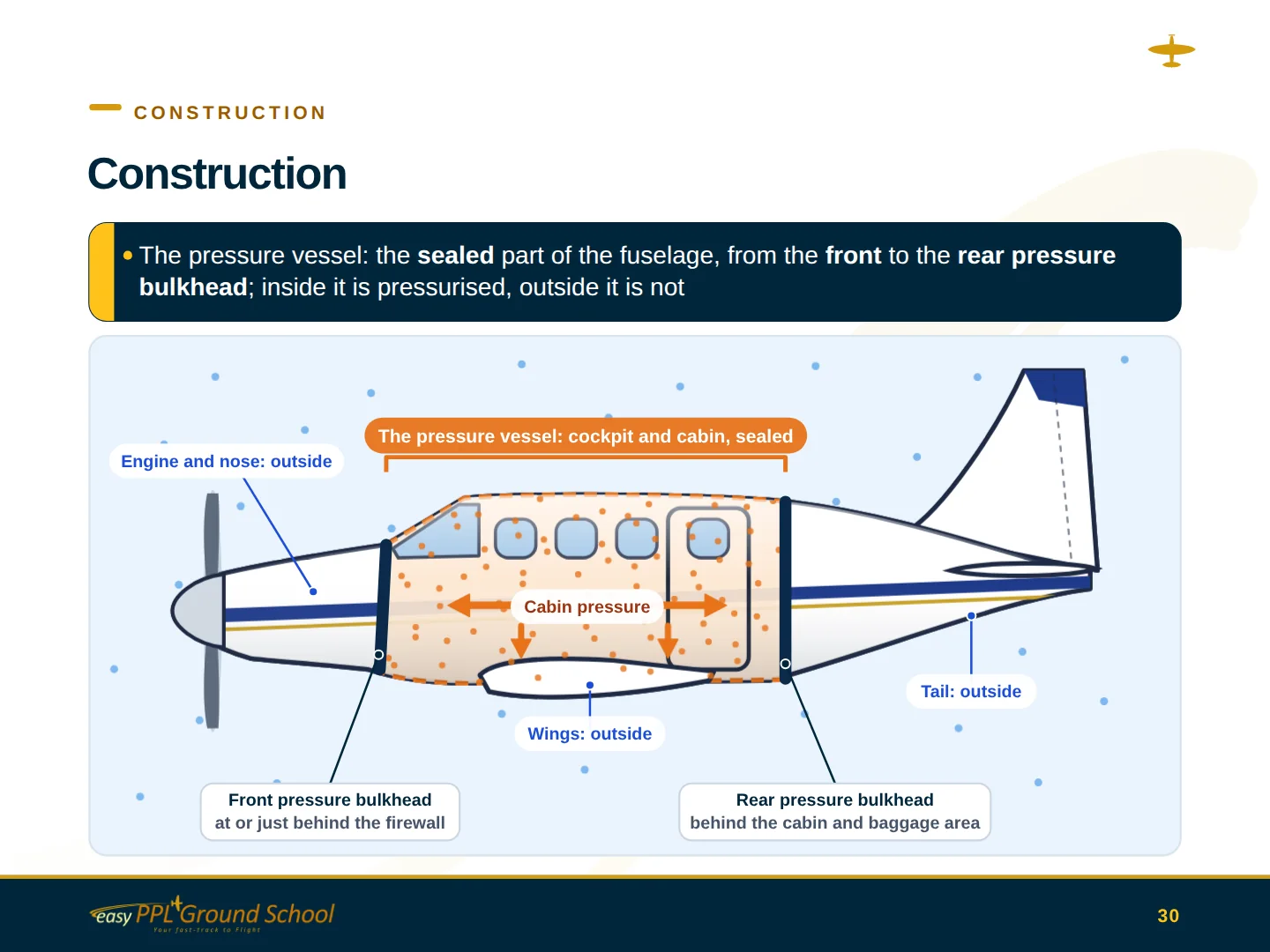
The pressure vesselChapter 3 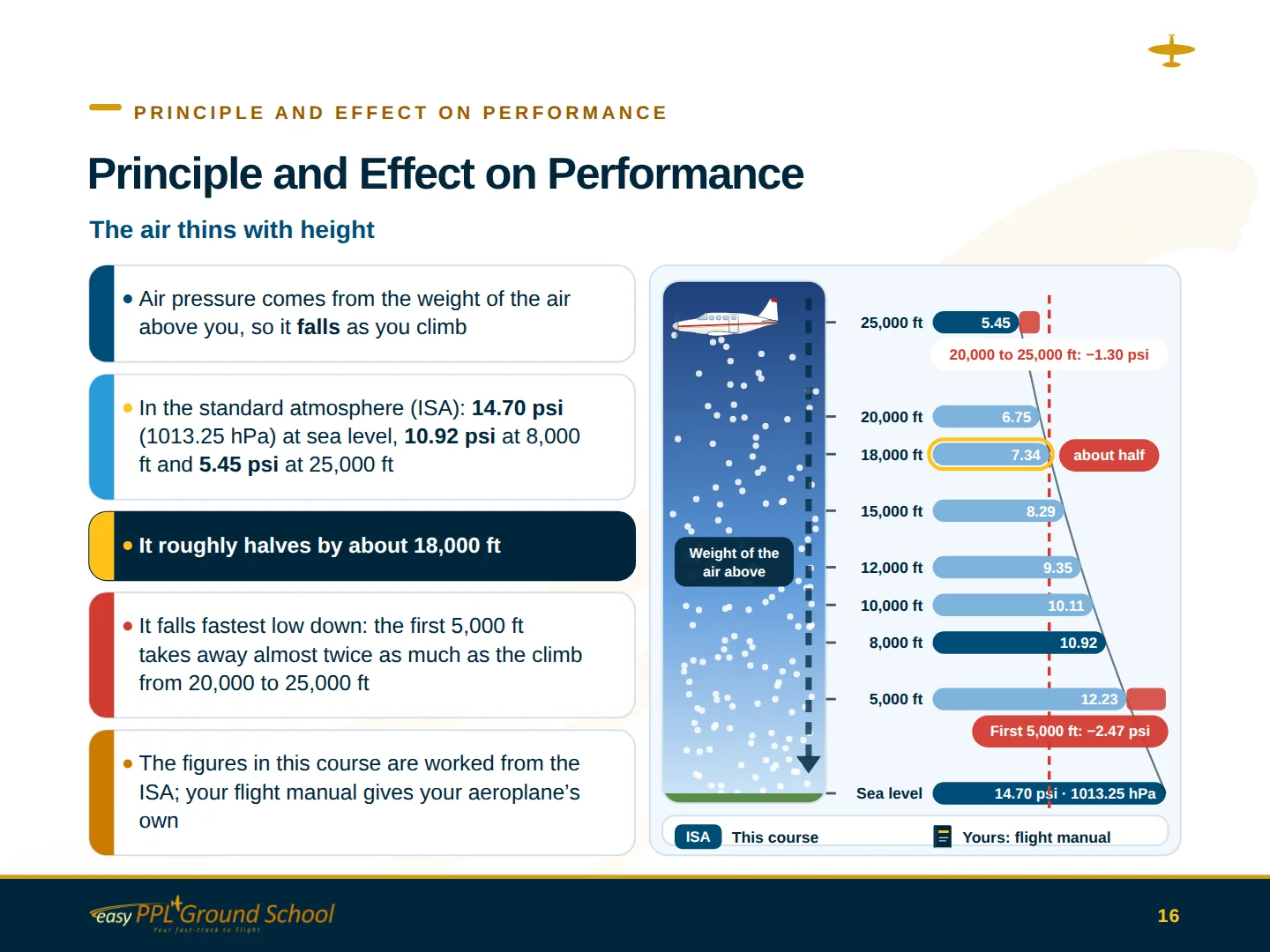
The air thins with heightChapter 2 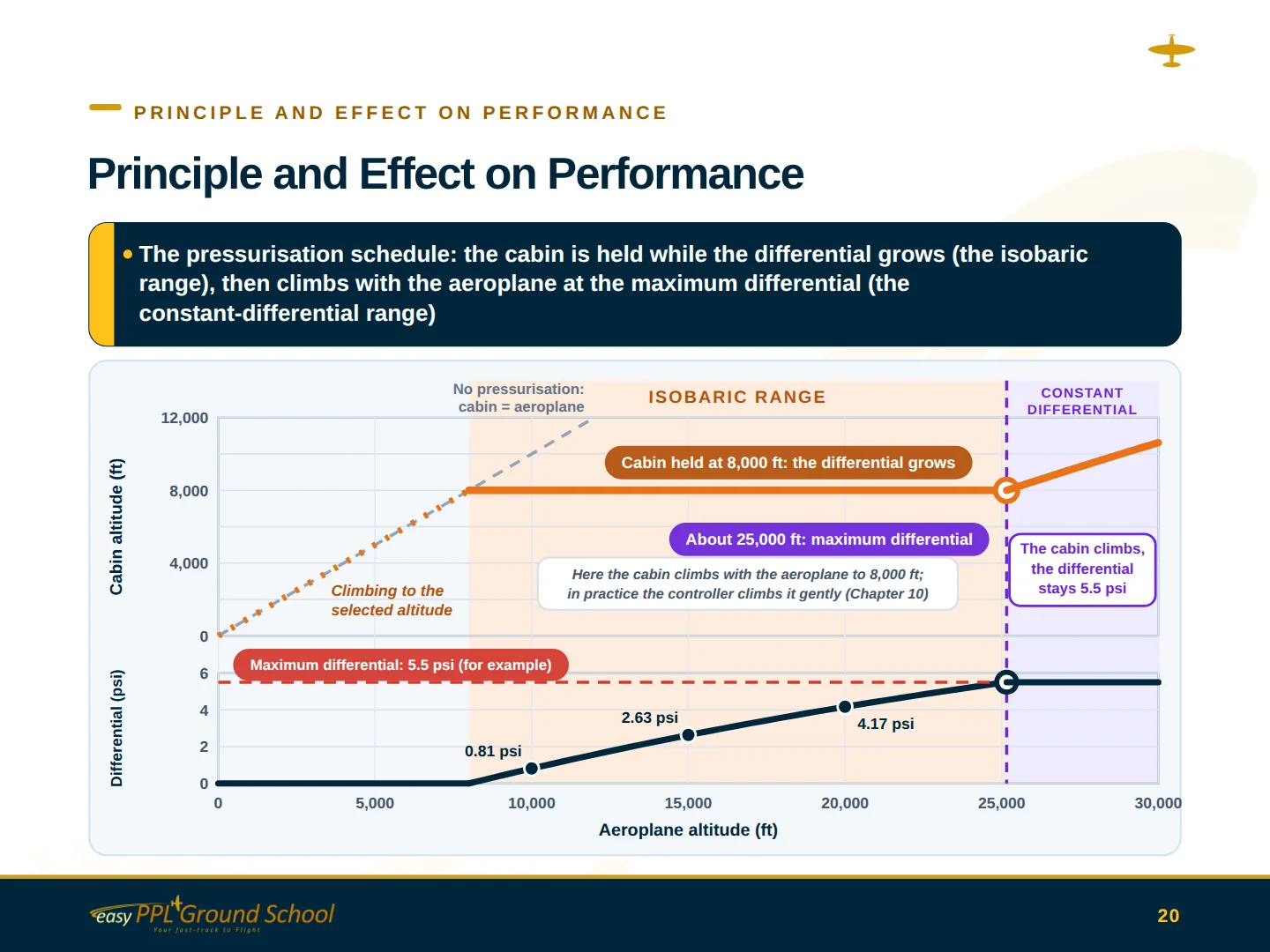
The pressurisation scheduleChapter 2 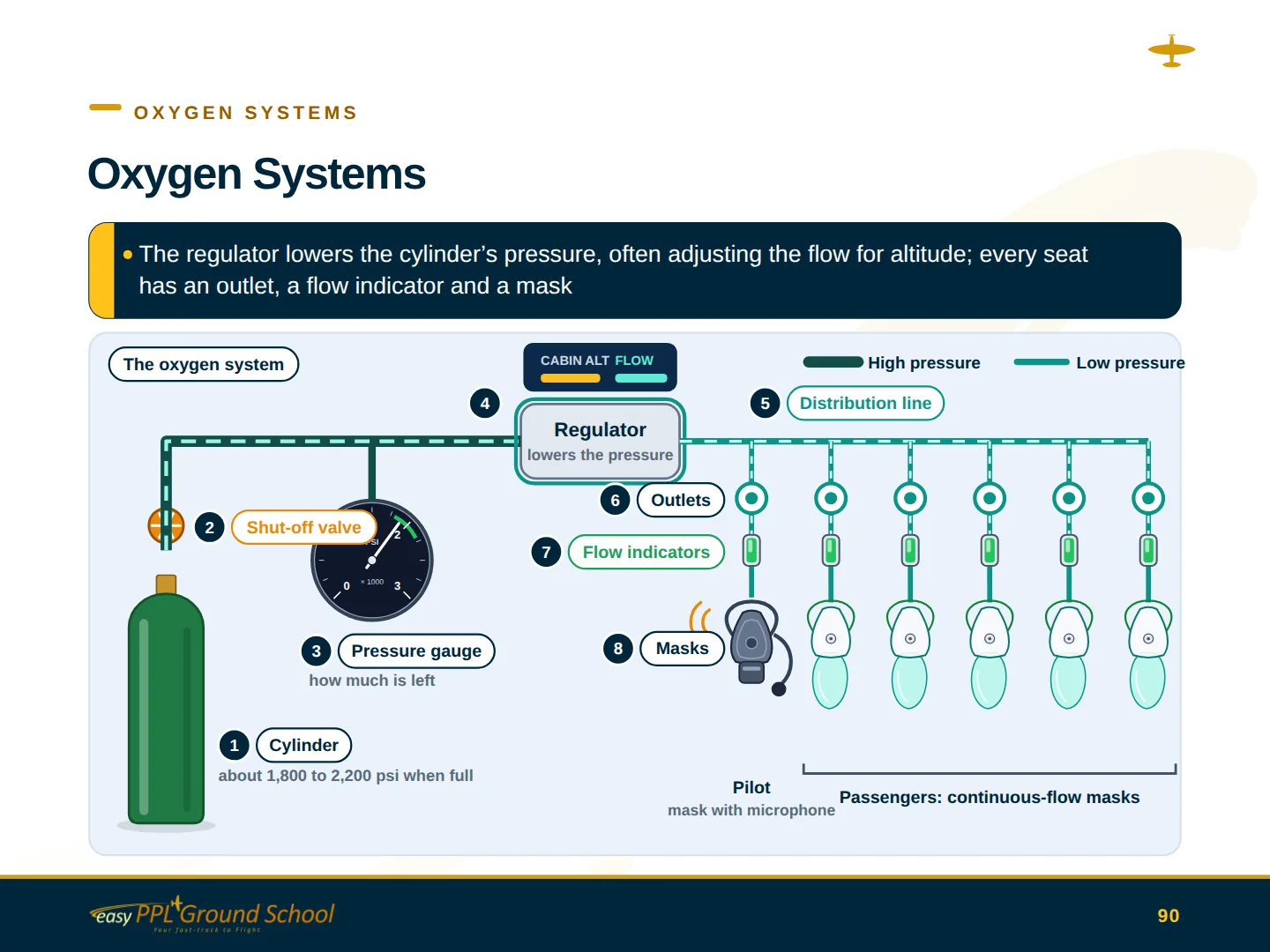
The oxygen systemChapter 7 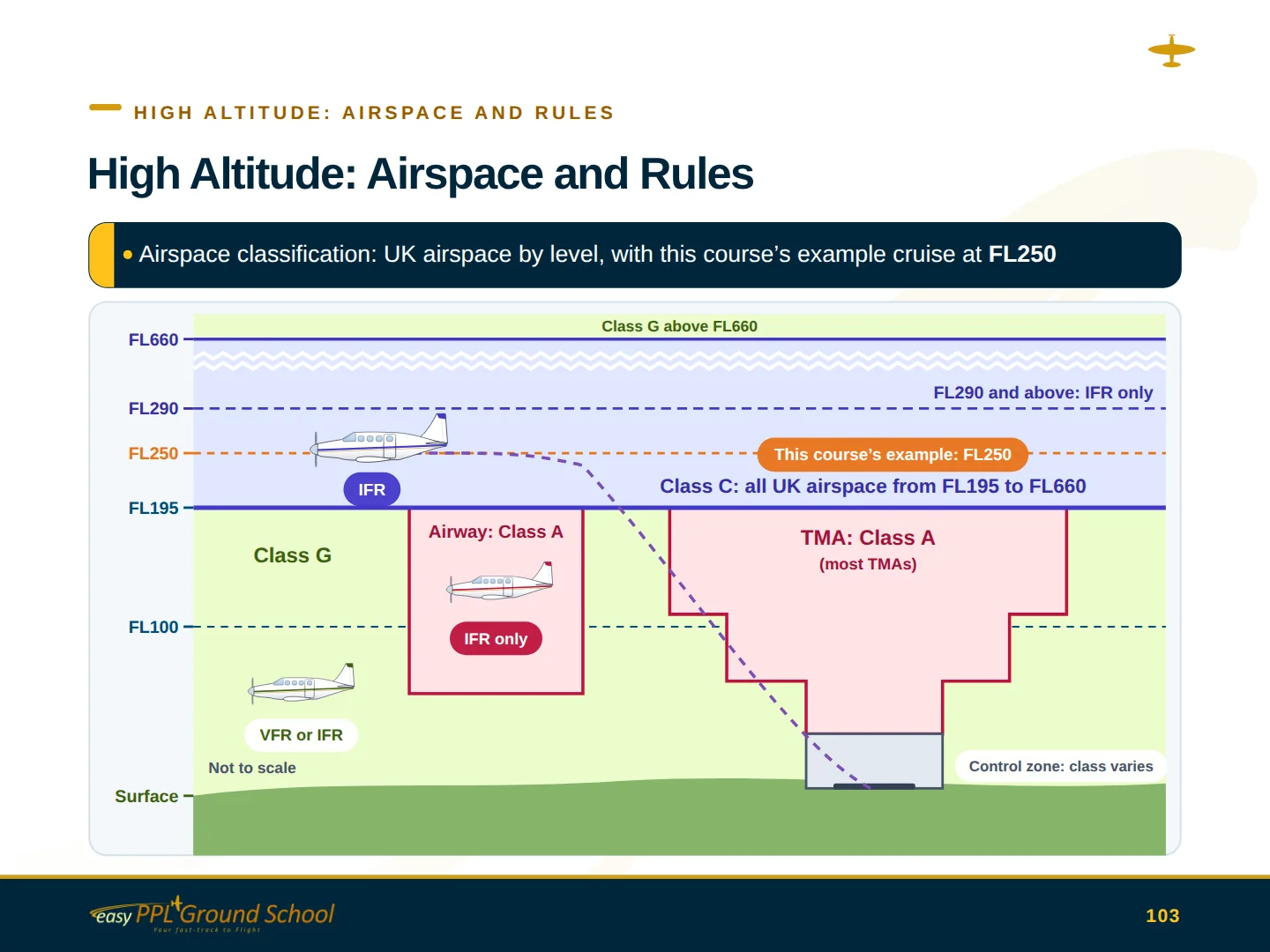
UK airspace by levelChapter 8 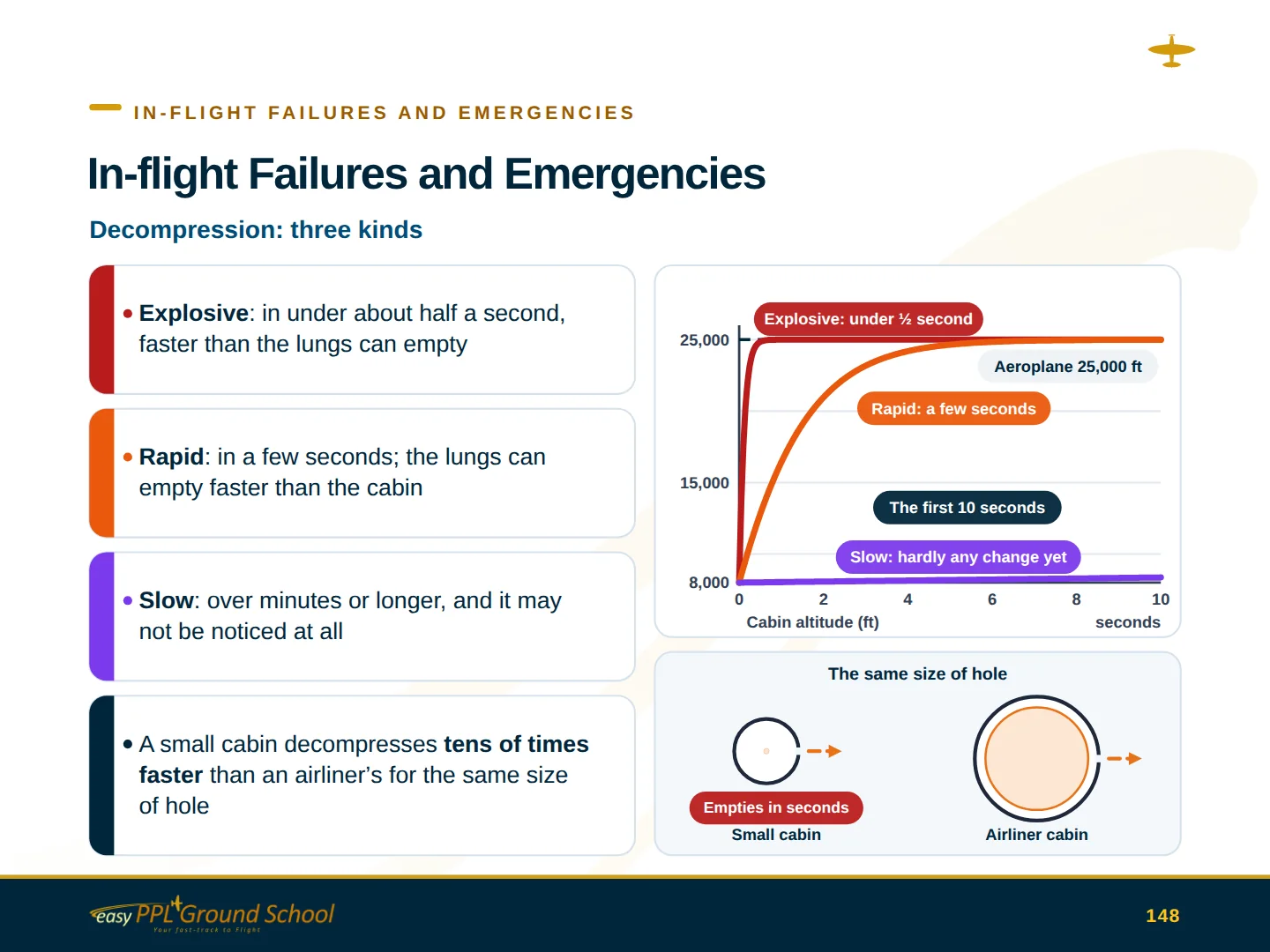
Three kinds of decompressionChapter 11
What's included
Everything you need, in one place
- 168 animated slidesEach one built up step by step while three narrators teach it, in 11 chapters.
- Classic slides tooPrefer still pictures? Switch to Classic for each slide with a short spoken summary.
- 11 progress testsOne after every chapter, and every answer explained with a picture.
- Course exam30 questions on the whole course to finish.
- Certificate of completionYours when you pass the course exam.
- Kept up to dateUp-to-date material that stays up to date.
- Study anywhereOn your computer, tablet or phone.
Buy it now
Choose how you study
Full Course
£15.49for one month
Renew for £13.94 a month
- Every lesson in the course
- 11 progress tests
- The course exam
- 1 certificate
Test/Exam Access Only
£13.99for one month
Renew for £13.99 a month
- 11 progress tests
- The course exam
- Ideal for revision
No account needed to add to your basket: you'll register (free) at checkout, and your course opens as soon as you've paid.